In this guide
The average American home contains around 300,000 items—from paper clips to furniture. Most of it sits unused. A UCLA study found that 75% of families can’t park in their garage because it’s full of stored items. Seasonal decluttering isn’t about minimalism—it’s about not spending time and energy managing things that no longer earn their place in the house.
The order matters more than most people think. Starting in the room where the problem feels worst makes the process emotionally heavy from minute one. Starting where the win is fastest—a surface, a bathroom cabinet—builds momentum that carries into harder spaces.
The Four-Category Sort
Before any room gets touched, the sorting system needs to be set up. Four categories, four physical spots in the room or hallway:
- Keep. Goes back in the room. Has a place. Gets used.
- Donate. Still good. Someone else will use it. Bag it and move it toward the door.
- Trash. Broken, expired, worn beyond use. In the bin.
- Decide later. Genuinely uncertain. Boxed, dated, and given 30 days. If it hasn’t been opened in 30 days, donate the whole box without looking inside.
The decide-later box is where most decluttering efforts stall. The 30-day rule solves this. The National Association of Professional Organizers found that 80% of what people keep “just in case” is never used again. If it hasn’t been opened in a month, it won’t be.
Start Here: Surfaces Before Storage
Flat surfaces—countertops, tables, shelves, the top of the dryer—are where clutter lives visibly. Clearing them first produces the most immediate visual change and makes every room feel different before anything in the drawers or closets has moved.
The rule for any flat surface: everything on it should be there by design, not by default. A lamp is by design. A pile of mail, three remote controls, a phone charger, and two empty cups are by default. Defaults move to their correct location or leave the room.
Mail is the most common flat-surface problem. The United States Postal Service delivers an average of 421 pieces of mail per American household per year. Most of it is junk or handled once and set down. A single inbox—one physical spot—replaces the random surface landing. Process it weekly. Anything more than a week old gets recycled or filed.
The Bedroom: Clothes First
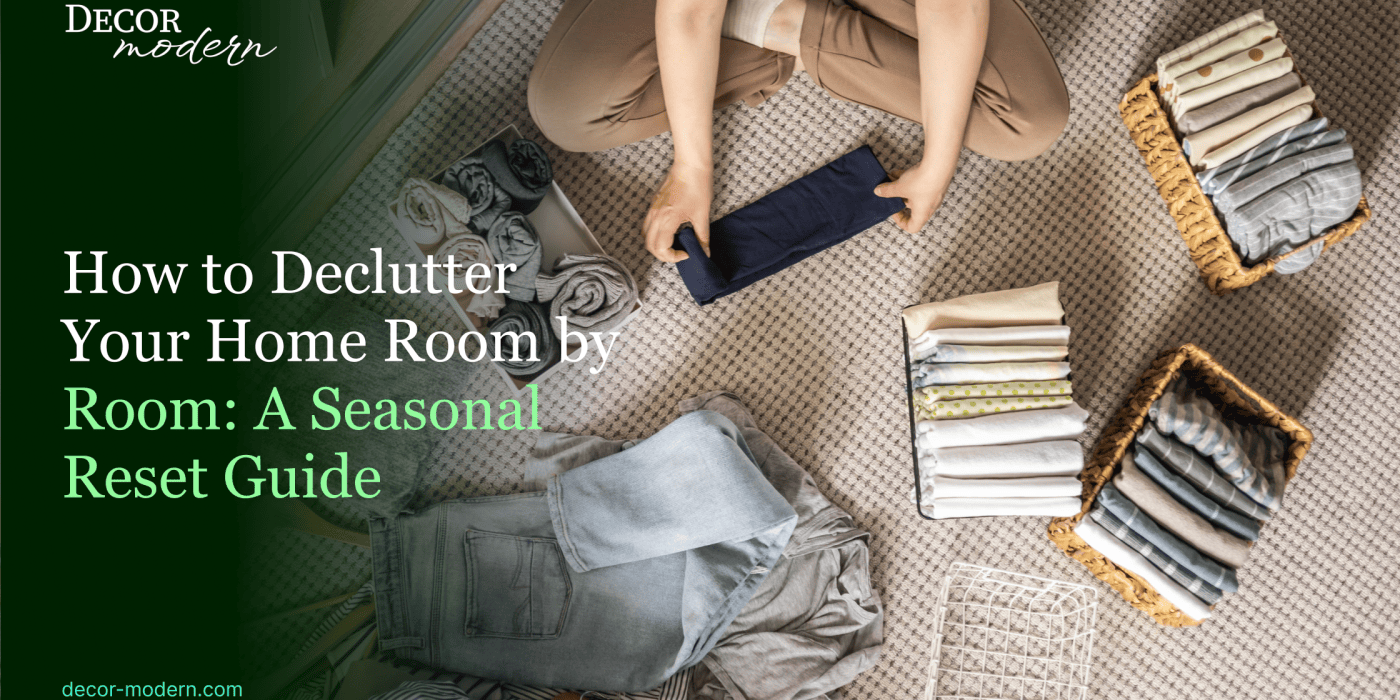
The bedroom accumulates clutter in two forms: things that belong in other rooms and clothes that no longer fit the person or their life. The clothes are the bigger problem—they take up closet space, make getting dressed harder, and rarely get reconsidered until a full clear-out forces it.
The one-year rule for clothing: if it hasn’t been worn in 12 months, it leaves. No exceptions for “when I lose weight” or “when I need something formal.” The average American throws away 81 pounds of clothing per year—EPA data—most of it going to landfill. Donating rather than trashing keeps usable items in circulation. Local shelters, Goodwill, ThredUp, and Buy Nothing groups take clothing in good condition.
Seasonal rotation is the practical system: winter coats, heavy sweaters, and boots move to a labeled bin in storage when the season ends. Summer clothes come out. The closet holds only what’s appropriate for the current season, which makes the wardrobe feel larger and daily decisions easier.
While clearing clothes: check under the bed. Under the bed is where things go to disappear—returns that never got made, items in the wrong season, things that were put there temporarily three years ago. Clear it completely. If under-bed storage is intentional, use labeled, flat bins.
The Kitchen: Duplicates and Expiry Dates
Two problems dominate kitchen clutter: too many of the same thing and food that’s past its use-by date.
The average American kitchen has over 40 cooking tools and gadgets. Most households use fewer than 10 regularly. The avocado slicer, the spiralizer, the ice cream maker used once—these take up drawer and cabinet space that more-used items need. If it hasn’t come out in a year, it leaves.
The pantry and refrigerator get checked for expiry dates during a seasonal reset. Pull everything out. Check dates. Anything expired goes. Anything with less than two months remaining gets moved to the front and into meal planning for the week. What’s left gets organized by category—grains together, canned goods together, spices together.
Spice cabinets are the most frequently neglected area in a kitchen. Ground spices lose most of their potency within 1 to 3 years. Whole spices last 3 to 5 years. A spice that’s been in the cabinet since the last address is almost certainly not adding anything to food.
The Living Room: The Landing Zone Problem
Living rooms accumulate other people’s things. Bags, shoes, chargers, kids’ items, mail, books left face-down—these are temporary placements that become permanent fixtures. The living room is usually the room visitors see first, which makes clutter here the most visually impactful.
Every item in a living room should have a specific home that isn’t the couch arm or the coffee table corner. Chargers go in one place—a drawer, a basket, a charging station. Remotes go in one place. Reading material goes in one place. The landing zone problem disappears when there’s a specific location for each category of item that gets left in the room.
Seasonal decor is worth rotating deliberately. The National Retail Federation reports that Americans spend an average of $902 on holiday decorating per household per year. Much of it sits in storage for 11 months. A seasonal clear-out is the right time to assess what actually comes back out each year and what gets stored, forgotten, and stored again.
The Bathroom: Small Space, High Accumulation
Bathrooms accumulate products faster than any other room relative to their size. Shampoo bottles that aren’t quite empty, face wash bought to try once, medicine cabinet items that expired during a different administration.
The FDA recommends checking medication expiry dates and disposing of expired medications safely—many pharmacies offer take-back programs for this purpose. Expired medications shouldn’t go in the trash where children or animals can access them, or down the drain where they enter the water supply.
The consolidation rule: any two products in the same category that are both partially used get combined into one container or the older one gets used first. Half-empty bottles of the same shampoo take up twice the shelf space for no benefit.
Towels and linens stored in the bathroom get assessed for condition. Frayed, thinned, or stained towels that wouldn’t be put out for a guest don’t stay. Old towels in good condition go to animal shelters—most accept them and use them for bedding.
The Garage and Basement: Seasonal Separation
Garages and basements fail because everything gets stored in the same space without organization—holiday decorations next to garden tools next to camping gear next to items waiting to be donated. Nothing has a clear zone.
The fix is zoning by category and season. The National Association of Professional Organizers recommends clear labeled bins over cardboard boxes for any storage that sits for more than a few months. Clear bins allow contents to be seen without opening. Labels that say what’s inside, not just the season, make retrieval faster.
Items that haven’t been touched in two or more years in a garage or basement are strong donate or discard candidates. The exception: genuine emergency supplies, tools for home maintenance, and items with clear future use. The “might need it someday” category is where garages go wrong.
Room-by-Room Reference
| Room | Biggest clutter source | Seasonal swap to make |
| Bedroom | Clothes that no longer fit or get worn | Rotate seasonal clothing to storage |
| Closet | Items kept out of guilt or ‘just in case’ | Pull out off-season items; store or donate |
| Kitchen | Duplicate tools and expired pantry items | Check expiry dates; clear rarely used gadgets |
| Living room | Surfaces used as landing zones | Clear flat surfaces; remove seasonal decor |
| Bathroom | Expired products and duplicates | Check dates; consolidate half-empty bottles |
| Home office / desk | Paper piles and unused tech | File, shred, or recycle; clear cables |
| Garage / basement | Seasonal gear mixed with daily items | Separate by season; label clearly |
Bottom Line
Seasonal decluttering works when it follows a sequence: surfaces before storage, fastest wins before hardest spaces, and a clear sorting system before anything gets touched. The decide-later box prevents paralysis. The 30-day rule clears it without revisiting every individual decision. What leaves the house matters less than making sure what stays has earned its place—and has somewhere to go that isn’t a flat surface.
Sources
Every external claim in this guide links to its origin. Collected automatically from the text above.
- 75% of families can't park in their garage — facebook.com
- The National Association of Professional Organizers — napo.net
- The United States Postal Service — usps.com
- The average American throws away 81 pounds of clothing per year — epa.gov
- over 40 cooking tools and gadgets — theatlantic.com
- The National Retail Federation — nrf.com
- many pharmacies offer take-back programs — fda.gov

Jane McKenna
Jane covers interior design, room-by-room planning, and the organizational side of home improvement for Decor Modern. Her articles help homeowners decide how a space should look and function before they start buying materials. Jane's path to home improvement writing started in set design for small theater productions in New England — a job that taught her how to make any room feel intentional on almost no budget. She transitioned into residential interior consulting, working with homeowners on kitchen layouts, bedroom makeovers, and practical space planning that doesn't require an architect. After five years of in-person consultations, she began writing to reach people who couldn't afford a designer but still wanted thoughtful guidance. Over the course of her consulting work, she has worked with dozens of homeowners on kitchen layouts, bedroom redesigns, and space planning decisions — often within tight budgets and existing structural constraints. On Decor Modern, she writes the interior design styles guide, the bedroom and living room articles, and the kitchen remodel planning series. Her approach is pragmatic: she cares more about whether your kitchen layout actually works for cooking than whether it follows a trend. Her work focuses on functional design — layouts that improve how a space is actually used day-to-day, not just how it looks in photos. Jane is based in Connecticut, in a 1920s colonial that she and her husband have been updating room by room since they bought it — "slowly, and with a lot of opinions from each other."