

In this guide
A full bathroom renovation costs $6,000 to $16,000 on average—HomeAdvisor data. That’s not a project most homeowners take on frequently. But a bathroom that looks dated, dim, or worn doesn’t require a full teardown to feel different. Five targeted changes—all under $500 combined—address the elements that actually drive how a bathroom reads visually.
These five upgrades work because they focus on what the eye lands on first: light, fixtures, reflective surfaces, grout lines, and hardware. Update those and the bones of the room look better without touching a single tile.
Upgrade 1: Replace the Vanity Light
The light fixture above the mirror controls how the whole room looks and feels. Most builder-grade bathrooms ship with a basic bar fixture—either too dim, too warm, or casting unflattering shadows. The fixture itself costs $60 to $150 for a quality replacement; installation takes an hour if the wiring is already in the right position.
Vanity lighting that flanks the mirror on both sides eliminates shadows that overhead bars create. If the existing box position only allows for a bar, a fixture with individual bulb positions—rather than a single covered bar—distributes light more evenly. Bulb temperature matters: 2700K to 3000K (warm white) renders skin tones better than the cool blue-white of higher Kelvin LEDs—DOE lighting resource. Replace the bulbs when replacing the fixture.
Turn off the circuit at the breaker before starting. The fixture typically mounts to a standard electrical box—most new fixtures include a mounting bracket that works with existing hardware. The entire swap takes under two hours and requires a screwdriver and wire nuts.
Upgrade 2: Swap the Faucet
A faucet replacement is one of the most direct ways to update a vanity’s look. Chrome, brushed nickel, matte black, and oil-rubbed bronze carry completely different visual weights. Moen and Delta both make single-handle bathroom faucets starting around $50 to $80; mid-range options from the same brands run $80 to $120. Most modern faucets include the drain assembly, which eliminates one more piece of hardware that might be showing its age.
Check the sink’s hole configuration before buying: single-hole, three-hole, and widespread are not interchangeable. Most vanity sinks are three-hole (two for handles, one for the spout) or single-hole (one opening for a combined unit). The faucet packaging lists which holes it requires.
Shut off the supply valves under the sink. Disconnect the supply lines and drain linkage. The new faucet drops in from above and tightens with a basin wrench from below. The job runs 1 to 2 hours. No plumber required unless the shutoff valves themselves are corroded—at that point, call a plumber to replace the valves before installing the faucet.
Upgrade 3: Replace the Mirror
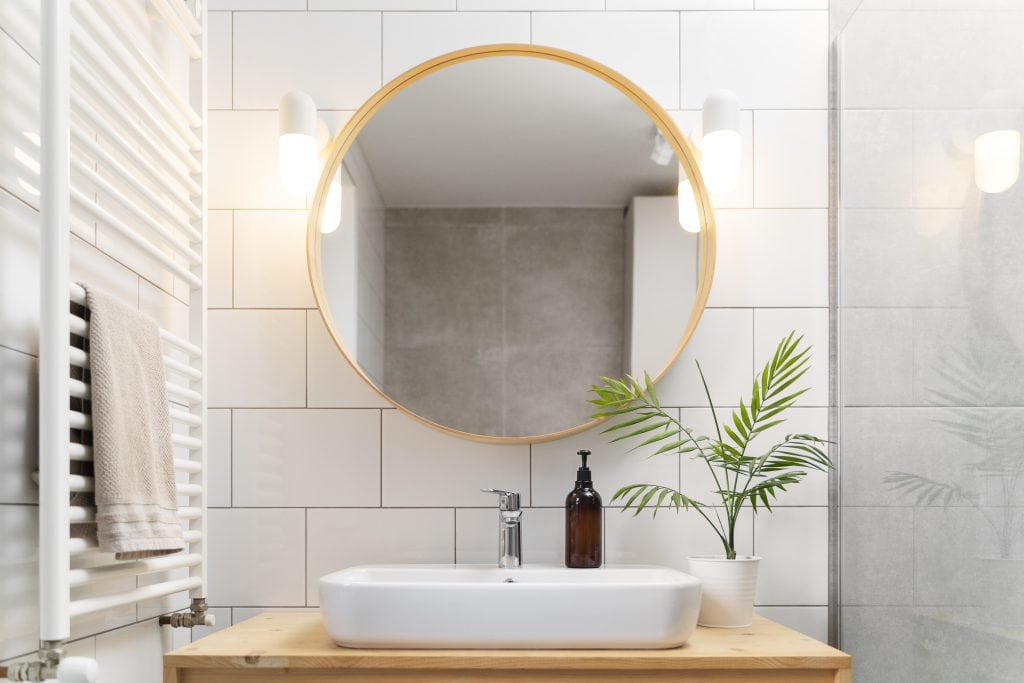
Most builder bathrooms have a frameless plate mirror clipped directly to the wall. It functions but contributes nothing visually. A framed mirror—or a decorative mirror in the right proportions—changes the room’s character significantly for $40 to $200.
The proportions matter more than the style. The mirror should be roughly the same width as the vanity it sits above—or slightly narrower. A mirror that’s too narrow makes the vanity look wider than it is; one that extends well past the vanity edges feels unanchored. Bathroom design guidance recommends leaving 5 to 10 inches of clearance between the top of the mirror and the ceiling, and centering it with the light fixture above.
Removing a builder clip mirror requires care—they’re typically secured with clips at the top and may be glued at the bottom. Run a utility knife along the bottom edge before prying. Hang the new mirror using appropriate wall anchors for its weight; mirrors are heavier than they look.
Upgrade 4: Regrout and Recaulk
Grout that’s cracked, stained, or discolored makes clean tile look dirty. Caulk around the tub or shower base that’s darkened or peeling signals moisture and mold regardless of how often the room is cleaned. Refreshing both transforms aged tile back to clean tile—and costs $20 to $40 in materials.
For discolored grout, a grout pen or grout paint fills and recolors existing grout without removal—a one-hour job that covers a typical shower surround or floor. For cracked or crumbling grout, removal with a grout saw and fresh grout application is a half-day project. Both options produce dramatically better results than cleaning alone.
The caulk line at the tub-to-wall joint, the vanity-to-wall joint, and around the base of the toilet is the area that shows age fastest. Remove the old caulk with a caulk remover tool—about $5—clean the surface thoroughly, and apply new silicone caulk. The fresh line takes 24 hours to cure. Don’t use the shower during that window.
Upgrade 5: Replace the Hardware
Towel bars, toilet paper holders, robe hooks, and towel rings are often the last things replaced in a bathroom—and the first things that visually date it. A matching hardware set in a current finish runs $30 to $100 at most home improvement retailers. The swap takes about an hour per piece; a full bathroom set takes a morning.
The only constraint is matching the finish to the faucet and light fixture. Brushed nickel faucet and matte black towel bar works in a deliberate mixed-metal approach; mismatched finishes without intention read as unfinished. If the faucet is being replaced as part of this project, pick the hardware finish to match the new faucet.
Most hardware mounts to wall anchors or directly to studs depending on placement. Towel bars bear real weight—use the provided anchors rated for the load, or locate a stud behind the drywall for a more permanent mount. A towel bar that pulls out of the wall within a year was never properly anchored.
The Five Upgrades at a Glance
| Upgrade | Cost Range | Time to Complete | Biggest Visual Impact |
| Vanity light fixture | $60–$150 + 1 hour | 1–2 hours | Changes the mood of the whole room |
| Bathroom faucet | $50–$120 + 1–2 hours | 1–2 hours | Updates the focal point of the vanity |
| Mirror replacement | $40–$200 | 30 minutes | Makes the room feel larger |
| Grout and caulk refresh | $20–$40 materials | Half day | Transforms aged tile to clean tile |
| Hardware swap (towel bars, TP holder) | $30–$100 for a set | 1 hour | Unifies the look across the whole room |
Costs based on HomeAdvisor pricing data and current retailer pricing. DIY labor assumed throughout.
What to Do in What Order
If doing all five, the sequence matters. Grout and caulk first—the mess from regrout splatter lands on everything below it. Mirror next, since the hanging hardware goes into the wall before the final accessories do. Faucet and light fixtures can happen in either order. Hardware lasts—it goes on clean walls after everything else is done.
Each upgrade works independently. Replacing just the faucet and mirror on a $150 budget still moves the room. Replacing just the vanity light fixture on an $80 budget still changes how the room reads at night. The five work best together, but none of them requires the others.
Bottom Line
The five upgrades—vanity light, faucet, mirror, grout and caulk, and hardware—together run under $500 in materials and under a weekend in labor. Remodeling Magazine’s Cost vs. Value report shows bathroom updates consistently among the highest-return renovations at resale. The targeted approach here skips the tile, the tub, and the vanity cabinet—the expensive parts—and focuses on the elements that drive first impressions.
Sources
Every external claim in this guide links to its origin. Collected automatically from the text above.
- $6,000 to $16,000 on average — homeadvisor.com
- Bulb temperature matters: 2700K to 3000K (warm white) renders skin tones better — numberonelights.com
- Moen and Delta both make single-handle bathroom faucets starting around $50 to $80 — homedepot.com
- Bathroom design guidance — edwardmartin.com
- grout pen or grout paint — lowes.com
- $30 to $100 at most home improvement retailers — lowes.com
- HomeAdvisor pricing data — homeadvisor.com
- Remodeling Magazine's Cost vs. Value report — remodeling.hw.net

Nina Kowalski
Nina covers flooring, renovation planning, and DIY repair guides for Decor Modern. Her focus is translating contractor-level knowledge into step-by-step instructions that a homeowner can actually follow on a Saturday morning. Before writing about home improvement, Nina spent four years managing renovation projects for residential properties in the Midwest — coordinating work between flooring installers, painters, and general contractors. She worked on projects ranging from single-room updates to full-home renovations, gaining firsthand experience in budgeting, timelines, and contractor coordination. That experience taught her which shortcuts work, which ones backfire, and how much things really cost when the estimate meets reality. She saw how initial estimates change once work begins — and which decisions tend to increase costs or cause delays. Her most-read articles on Decor Modern include a guide to fixing scratches on hardwood floors and a breakdown of the cost to refinish hardwood floors. She also writes the site's cost comparison pieces, where she digs into real pricing data rather than repeating vague national averages. Her writing is grounded in real project constraints — including labor availability, material costs, and unexpected issues that arise during renovation. Nina holds a degree in Communications and has contributed home improvement content to several online publications. She lives in Ohio, where she is currently refinishing the original oak floors in a 1948 Cape Cod — one room at a time.