
In this guide
Kitchens are harder on floors than any other room in the house. Spills, heavy foot traffic, dropped pans, and cooking humidity all occur in the same 100–200 square feet, often multiple times a day. What works in a bedroom won’t last here.
This guide covers 11 kitchen flooring materials—what each costs, how long it lasts, and which households it actually suits.
What to Decide Before You Pick a Material
Three questions narrow the field quickly:
- How much water does your kitchen see? If you have kids, dogs or a dishwasher that runs often—your kitchen needs a waterproof floor. Someone cooking solo three nights a week has more options.
- What’s your budget for materials and installation combined? Labor can equal or exceed material costs on tile and stone. The cheapest material often isn’t the cheapest floor.
- How long are you staying? A rental or a flip has different requirements than a home you’re in for 20 years. Lifespan and refinishing potential matter more in the latter.
1. Porcelain Tile
Porcelain is denser than ceramic and fired at higher temperatures—that’s what gives it a water absorption rate below 0.5%, making it effectively waterproof. It handles scratches, stains, and heat well, and a properly installed floor lasts 15–50 years.
The trade-offs: cold underfoot, hard on joints if you stand for long stretches, and glossy finishes turn slippery when wet. Grout lines need sealing every 2–5 years. Professional installation is required. The material demands specialized cutting tools and subfloor load verification before going in on upper floors.
- Materials: $3–$15/sq ft; installed: $15–$50/sq ft.
- Ideal For: heavy-traffic kitchens, homes with pets, radiant heating systems.
2. Luxury Vinyl Plank (LVP)
LVP is a popular kitchen flooring choice for good reason. Waterproof rigid core, realistic wood visuals, and click-lock installation that most homeowners can handle themselves. Wear layer thickness determines how long it lasts—6–12 mil for budget options, 20+ mil for premium.
- Stone Polymer Composite (SPC) cores resist denting in high-traffic areas.
- Wood Polymer Composite (WPC) cores are softer underfoot, which matters if you spend long hours standing.
Heavy furniture can warp the surface over time. Direct sunlight fades it. Moisture underneath—from a concrete slab without a vapor barrier—can still cause problems despite the waterproof top layer.
- Materials: $2–$8/sq ft; installed: $3.50–$12/sq ft.
- Ideal For: active households with pets, DIY installers, anyone wanting a softer surface than tile.
3. Ceramic Tile
Ceramic is fired at lower temperatures than porcelain. It has a water absorption rate of 3–10%—good but not waterproof. It’s the budget-friendly tile option, with a wide range of colors, sizes, and patterns. Glazed surfaces resist stains and clean up easily.
It cracks more readily than porcelain when floors flex or settle. Dropped dishes tend to shatter on impact. Like porcelain, it’s cold and hard underfoot, and grout lines need periodic sealing.
- Materials: $3–$15/sq ft; installed: $12–$45/sq ft.
- Ideal For: moderate-traffic kitchens, budget renovations.
4. Engineered Hardwood
Engineered hardwood uses a genuine hardwood veneer bonded to a cross-ply plywood or HDF core. It is recommended for kitchens because the layered core resists warping well under humidity fluctuations. Wear layers of 3mm or more can be sanded and refinished 1–4 times; thinner veneers cannot.
Standing water still damages it—the improvement over solid wood is a degree, not a category. Scratches and dents happen from pet claws and dropped utensils. Premium products with waterproof cores exist but cost accordingly.
- Materials: $5–$13/sq ft; installed: $9–$20/sq ft.
- Ideal For: homeowners who want real wood without solid hardwood’s moisture sensitivity.
5. Laminate
Laminate delivers wood and stone looks at the lowest material cost of any option here. The melamine resin wear layer resists scratches well, and click-lock installation is DIY-friendly. AC3 rating handles standard residential traffic; AC4 or AC5 if the kitchen is high-use.
Standing water is the critical weakness—moisture getting into seams causes the HDF core to swell and buckle, and that damage is permanent. Waterproof laminate versions exist but cost more and narrow the gap with LVP. Once worn, laminate can’t be refinished.
- Materials: $1–$5/sq ft; installed: $3–$13/sq ft.
- Ideal For: budget builds, households that wipe spills immediately.
6. Natural Stone
Granite, marble, slate, and travertine each have distinct visual characteristics that manufactured products don’t replicate. Properly sealed stone is non-porous and lasts 50+ years. Granite and slate are the practical choices for kitchens—hard, scratch-resistant, and durable. Marble and limestone look premium but etch permanently from acidic spills (lemon juice, vinegar, wine) and need sealing every 6–12 months.
Stone is expensive in both material and labor. It’s also cold and hard underfoot. Repairs to chipped or cracked stone are rarely seamless.
- Materials: $5–$250/sq ft (marble at the high end); installed: $10–$45/sq ft.
- Ideal For: premium kitchens, granite or slate specifically for high-traffic family use.
7. Luxury Vinyl Tile (LVT)
LVT offers the same waterproof rigid core as LVP but in square and rectangular tile formats—better suited for stone-look designs. Large-format 12×24 tiles minimize grout lines. Advanced printing replicates marble, slate, and travertine convincingly. The cushioned underlayer reduces fatigue compared to real stone, and sound absorption cuts noise transmission between floors by up to 19dB.
Lifespan is shorter than porcelain (15–25 years vs. 50+). Direct sunlight causes fading. Glue-down installations are difficult to remove.
- Materials: $2–$12/sq ft; installed: $4–$17/sq ft.
- Ideal For: stone look without stone cost or maintenance, wet zones near sinks and dishwashers.
8. Solid Hardwood
Solid hardwood can be sanded and refinished 5–10 times over its lifespan, which is why a floor lasts 60–100+ years. The warmth and visual continuity it creates in open-concept spaces are difficult to replicate. Unfinished planks installed and stained on-site create seamless transitions between rooms.
Moisture is the main problem—spills left standing cause warping, cupping, and swelling. Humidity fluctuations between seasons trigger expansion and contraction—proper gaps and consistent indoor humidity (35–55%) are a must. Not recommended directly in front of dishwashers or sinks without proper maintenance.
- Materials: $5–$10/sq ft domestic, $8+ tropical; installed: $11–$25/sq ft.
- Ideal For: open-concept homes, homeowners committed to immediate spill cleanup.
9. Cork
Cork contains suberin—a naturally waxy compound that repels water, resists mold, and provides antimicrobial properties. The cellular structure gives it natural cushioning that reduces foot and joint fatigue during long cooking sessions, more so than any hard surface. It’s also a renewable resource; harvesting doesn’t require cutting down the tree.
It needs resealing every 12–18 months to maintain water resistance. Heavy furniture leaves permanent indentations. Pet claws scratch it more easily than vinyl or tile. UV exposure causes fading.
- Materials: $3–$9/sq ft; installed: $5–$17/sq ft.
- Ideal For: comfort-focused kitchens, eco-conscious homeowners.
10. Bamboo
Strand-woven bamboo is compressed under intense heat and pressure, making it 2–3 times harder than oak or maple and more scratch-resistant than most wood alternatives. It matures in 5 years vs. 40–80 for hardwoods. Strand-woven versions can be refinished at least twice. Horizontal and vertical bamboo types are softer and scratch more easily—spec carefully.
Standing water left for 20+ hours causes damage. Direct sunlight fades the color. Quality varies widely between manufacturers, and some imports contain urea-formaldehyde adhesives—check certifications before buying.
- Materials: $1–$6/sq ft; installed: $7–$16/sq ft.
- Ideal For: eco-conscious homeowners, high-traffic kitchens with pets (strand-woven only).
11. Concrete
Polished and sealed concrete is one of the most durable options available—standard polished concrete runs $3.50–$5/sq ft, significantly less than white oak hardwood or natural stone. Sealed properly, it resists water, mold, and heavy traffic and can last a lifetime. Overlays with polymer resins can go over existing substrates without full slab replacement.
It’s cold and unforgiving underfoot—extended standing is uncomfortable without anti-fatigue mats. Concrete amplifies sound. Cracks develop over time from settling or temperature shifts. Dropped items shatter. Radiant heating offsets the cold but adds cost.
- Materials: $2–$30+/sq ft depending on finish complexity; installed: same range.
- Ideal For: modern, industrial, or farmhouse kitchens; warm climates or homes with radiant heating.
Side-by-Side Comparison
| Material | Water Resistance | Lifespan | Material Cost/sq ft | Total Installed/sq ft | Best For |
| Porcelain Tile | Excellent (<0.5% absorption) | 15–50 yrs | $3–$15 | $15–$50 | Heavy traffic, pets, wet areas |
| Luxury Vinyl Plank | Excellent (waterproof core) | 15–25 yrs | $2–$8 | $3.50–$12 | Pets, spills, DIY installs |
| Ceramic Tile | Good (3–10% absorptio–n) | 15–25 yrs | $3–$15 | $12–$45 | Moderate traffic, budget builds |
| Engineered Hardwood | Moderate | 25–80 yrs | $5–$13 | $9–$20 | Wood look, humidity control |
| Laminate | Poor–Moderate | 15–25 yrs | $1–$5 | $3–$13 | Budget, wood esthetics |
| Natural Stone | Varies (sealing required) | 50+ yrs | $5–$250 | $10–$45 | Premium kitchens, granite/slate |
| Luxury Vinyl Tile | Excellent (waterproof) | 15–25 yrs | $2–$12 | $4–$17 | Stone look, wet zones |
| Solid Hardwood | Poor | 60–100+ yrs | $5–$10 | $11–$25 | Open-concept, low humidity |
| Cork | Moderate (resealing required) | 15–25 yrs | $3–$9 | $5–$17 | Comfort-focused kitchens |
| Bamboo | Moderate (not waterproof) | 20–30 yrs | $1–$6 | $7–$16 | Eco-conscious, pets |
| Concrete | Excellent (once sealed) | Lifetime | $2–$30+ | $2–$30+ | Modern/industrial style |
Which One Is Right for You
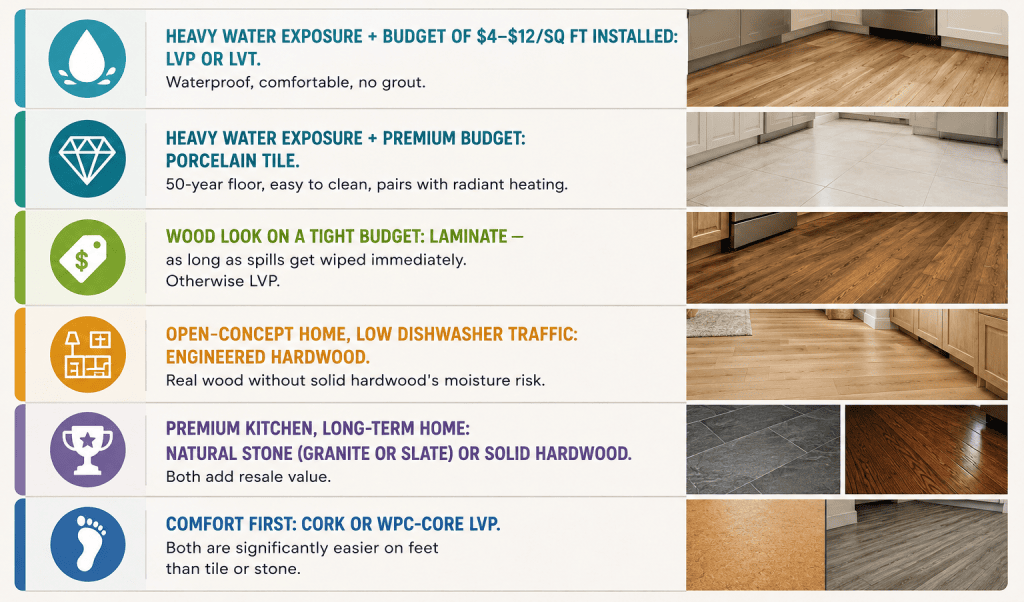
Installation costs often equal or exceed material costs on porcelain, stone, and hardwood—get complete installed-price quotes before comparing materials.
Bottom Line
There’s no single best kitchen floor. Porcelain and LVP lead on water resistance; solid hardwood and natural stone lead on longevity and resale value; laminate and LVP lead on cost. The right choice depends on how the kitchen is used—not on rankings or trends.
Sources
Every external claim in this guide links to its origin. Collected automatically from the text above.
- a water absorption rate below 0.5% — tile-assn.com
- click-lock installation that most homeowners can handle themselves — thespruce.com
- recommended — nwfa.org
- Properly sealed stone is non-porous and lasts 50+ years — marble-institute.com
- natural cushioning that reduces foot and joint fatigue — floorcoverings.com
- 2–3 times harder than oak or maple — bambooflooringchina.com
- standard polished concrete runs $3.50–$5/sq ft — concretenetwork.com

Nina Kowalski
Nina covers flooring, renovation planning, and DIY repair guides for Decor Modern. Her focus is translating contractor-level knowledge into step-by-step instructions that a homeowner can actually follow on a Saturday morning. Before writing about home improvement, Nina spent four years managing renovation projects for residential properties in the Midwest — coordinating work between flooring installers, painters, and general contractors. She worked on projects ranging from single-room updates to full-home renovations, gaining firsthand experience in budgeting, timelines, and contractor coordination. That experience taught her which shortcuts work, which ones backfire, and how much things really cost when the estimate meets reality. She saw how initial estimates change once work begins — and which decisions tend to increase costs or cause delays. Her most-read articles on Decor Modern include a guide to fixing scratches on hardwood floors and a breakdown of the cost to refinish hardwood floors. She also writes the site's cost comparison pieces, where she digs into real pricing data rather than repeating vague national averages. Her writing is grounded in real project constraints — including labor availability, material costs, and unexpected issues that arise during renovation. Nina holds a degree in Communications and has contributed home improvement content to several online publications. She lives in Ohio, where she is currently refinishing the original oak floors in a 1948 Cape Cod — one room at a time.