Hardwood floors look good and hold their value, but professional installation runs $8–$18 per square foot, which adds up fast. A single 300-square-foot room can cost $2,400–$5,400 before you’ve picked your species. Done carefully, this is a project a first-timer can handle.
Step 1: Measure, Choose, and Acclimate
Measurements
Multiply length × width, then add 10% for waste. For herringbone or diagonal layouts, add 15%. Break irregular rooms into rectangular sections and sum them.
Solid vs. Engineered
Solid hardwood (¾-inch planks) lasts 30–100 years and can be refinished multiple times—but it requires a plywood subfloor and can’t go below grade. Materials run $6–$9/sq.ft. Engineered hardwood (real veneer over plywood core) handles concrete and humidity far better at $4–$10/sq.ft. For basements, slabs, or radiant heat, engineered is the right call.
Acclimation
Solid hardwood needs 3–10 days in the installation room; engineered needs 48–72 hours. Keep the space at 60–80°F and 30–50% humidity. Use a moisture meter—acclimation is done when the flooring reads within 2–4% of the subfloor, not just when the days are counted.
Step 2: Prepare the Subfloor
Industry standards allow no more than ⅛ inch of variation within 6 feet. Check with a straight edge. Sand high spots, fill low ones with leveling compound. Wood subfloor moisture should read 12% or less (take 20+ readings per 1,000 sq.ft.). On concrete, relative humidity needs to be under 75%.
Fix squeaks, re-drive protruding nails, and repair soft spots before any boards go down. Issues here only get harder to fix once the floor is in.
Step 3: Tools You’ll Need
Two items are worth renting rather than buying: the pneumatic flooring nailer and the air compressor. Driving fasteners through tongue-and-groove at the 45° angle by hand is nearly impossible to do consistently. Everything else you either already own or can pick up cheaply.
| Tool | Buy or Rent | Price range | Notes |
| Pneumatic flooring nailer | Rent | $40–$80/day | Core installation tool—not optional for solid hardwood |
| Air compressor | Rent | $40–$60/day | Paired with the nailer; 70–90 psi required |
| Miter saw | Buy or rent | $150–$450 to buy | Optional if you already own one |
| Table saw | Buy or rent | $300–$600 to buy | Needed for ripping final rows to width |
| Jigsaw | Buy | $40–$130 | For irregular cuts around obstacles |
| Oscillating multi-tool | Buy | $50–$150 | Needed for undercutting door jambs; corded models cheapest |
| Moisture meter | Buy | $25–$60 | Pin-type is fine; needed before AND after acclimation |
| Tape measure (25–30 ft) | Buy | $10–$25 | A must-have for any situation |
| Chalk line | Buy | $8–$20 | For snapping straight reference lines on the subfloor |
| Pry bar | Buy | $10–$30 | Baseboard removal without tearing drywall |
| Tapping block + pull bar | Buy | $15–$30 (set) | Close gaps without damaging board edges |
| Carpenter’s square | Buy | $10–$20 | Verify 90° at corners and cuts |
| Spacers (¾ inch) | Buy | $5–$10 | Maintain expansion gap along all walls |
| Utility knife | Buy | $8–$15 | Trim underlayment, score caulk lines |
| N95 mask + safety glasses | Buy | $15–$25 | Sawdust and adhesive fumes are no joke |
| Knee pads | Buy | $15–$40 | You’ll be on the floor for hours |
Prices may vary and change over time. The prices in this table were sourced from Home Depot at the time of writing.
Step 4: Install
Prep the room
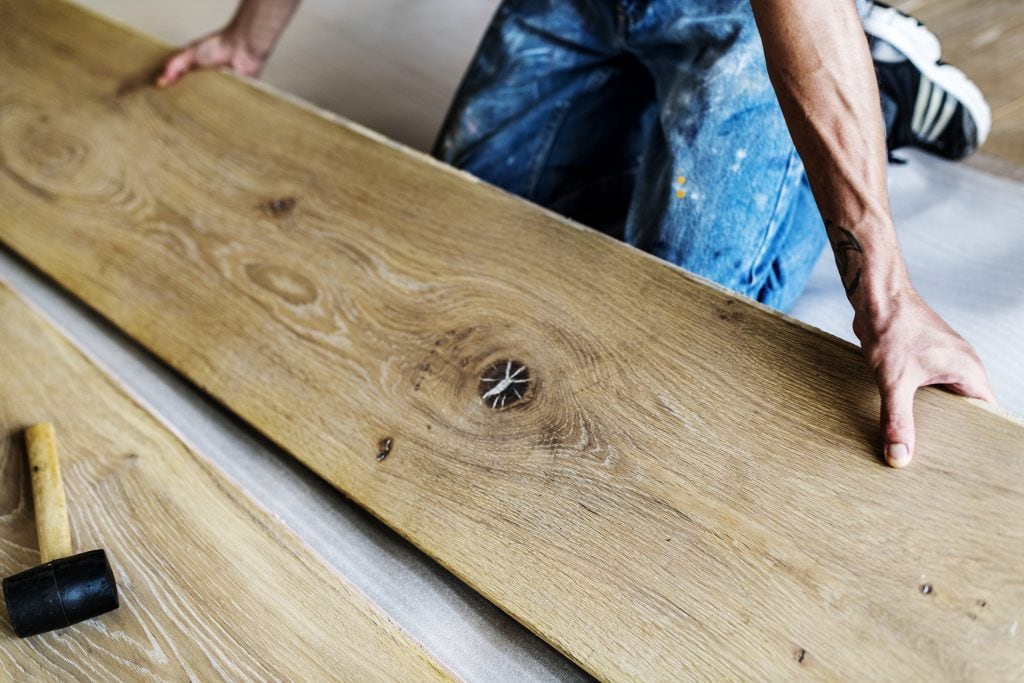
Score baseboard caulk before prying (skip this and you tear drywall). Number each piece and note its wall position. Remove old flooring, scrape the subfloor clean. Lay 15-lb asphalt-saturated felt paper as underlayment for nail-down over plywood—4–6-inch overlapping strips, stapled. On concrete, use a dedicated vapor barrier. One layer only.
Layout
Never start against a wall—they’re rarely straight, and any angle compounds row by row. Measure opposite walls and split the difference between gaps. Snap a chalk line parallel to your start wall, set ¾ inch back from it. Verify the square with a 3–4–5 triangle.
First rows
Groove faces the wall, spacers in place. Face-nail close to the wall edge (trim covers those), then blind-nail through the tongue at 45°. Before starting, rack boards from multiple boxes to mix color variation—15 extra minutes, noticeably better result.
Once 2–4 rows are down
Switch to the pneumatic nailer. Strike the actuator with a rubber mallet; it drives fasteners at the correct angle automatically. Space them every 6–8 inches along each board, within 2–3 inches of each end. Air pressure: 70–90 psi.
Stagger end joints at least 6 inches between adjacent rows. Avoid H-joints (four ends meeting in a grid)—they weaken the floor structurally. Use each row’s off-cut to start the next.
Door jambs
Undercut with an oscillating multi-tool, using a scrap of flooring as a depth guide. Boards slide underneath cleanly.
Final rows
Face-nail when the nailer won’t fit. Rip the last row to width on the table saw—minus ¾ inch for the gap. Use a pull bar to draw boards tight.
Expansion gaps
Leave ¾ inch around the entire perimeter. This is the most-skipped and most-consequential step. A floor with nowhere to expand will buckle.
Finishing
Nail baseboards into wall studs, not the floor. Fill nail holes with color-matched putty. Use T-molding for same-height transitions; reducer molding where floor heights differ.
The information above is based on NWFA installation standards and manufacturer installation guidelines for hardwood flooring.
Mistakes Worth Knowing in Advance
- Skipping moisture testing—most DIY floor failures start here, showing up as cupping or squeaks months later.
- No acclimation—expect visible gaps in winter or buckling in summer.
- Inconsistent nail spacing—leads to sections that flex underfoot and eventually squeak.
- No expansion gap—seasonal humidity swings will cause buckling within the first year.
- Starting against a crooked wall—that angle compounds with every single row.