Picking the right flooring sounds simple until you’re standing in a showroom staring at 40 planks with wildly different price tags. The wrong choice costs you twice—once at installation, once when you’re replacing it five years later. Most residential projects fall between $9 and $25 per sq ft installed.
Let’s review the best flooring types considering how resistant a wood species is to denting and wear (the Janka test or other similar ratings), installation price and lifespan.
1. White Oak
- Janka: 1,360.
- Installed: $10–$17/sq ft.
- Lifespan: 75+ years.
White oak has a cellular feature called tyloses that seals the grain and creates a natural moisture barrier. This is why it handles kitchen spills without cupping or warping. The closed grain also hides minor scratches well and takes stains across a wide tonal range. Can be refinished multiple times.
Best for: Living rooms, kitchens, hallways.
Skip in: Bathrooms.
2. Hickory
- Janka: 1,820.
- Installed: $14–$25/sq ft.
- Lifespan: 100+ years.
Hickory is a tough hardwood for residential use. Serious scratch and dent resistance makes it ideal for homes with pets or heavy foot traffic. It has its own downsides, though. It’s difficult to cut and install—DIY is usually not possible.
Best for: Entryways, hallways, high-traffic areas.
Skip in: Small contemporary rooms.
3. Red Oak
- Janka: 1,290.
- Installed: $6–$18/sq ft.
- Lifespan: 40–100 years.
Red oak is the most common hardwood in North America. It is reliable, widely available, and refinishable 4–6 times. The open grain accepts stains evenly and adds character, though scratches and finish wear are more visible than on tighter-grained species. At the lower end of the hardwood price range, it’s the sensible pick for real wood without a premium price tag.
Best for: Traditional and transitional interiors.
Skip in: High-moisture rooms.
4. Luxury Vinyl Plank (LVP)
- Installed: $4–$12/sq ft.
- Lifespan: 15–25 years.
Modern LVP stacks a wear layer, a printed design layer, and a waterproof WPC or SPC core. That core makes it 100% waterproof. Click-lock systems make it DIY-friendly. However, it does have its drawbacks: it can’t be refinished, fades in direct sunlight, and gets replaced rather than restored.
Best for: Bathrooms, basements, laundry rooms.
Skip in: Sun-heavy rooms.
5. Laminate
- AC rating: AC3–AC5.
- Installed: $3–$13/sq ft.
- Lifespan: 15–25 years.
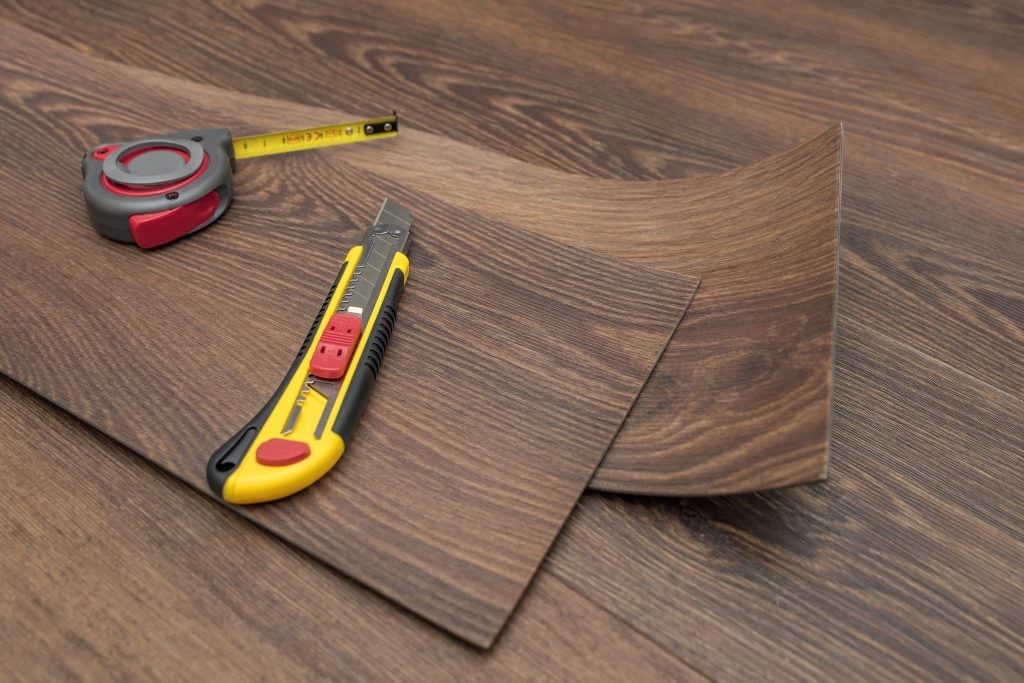
Laminate uses a photographic print beneath a protective resin coating on a fiberboard core. There is no real wood in the top layer, so it doesn’t need to be refinished. The AC rating tells you the durability class. AC3 covers heavy residential use; AC4–AC5 handle commercial traffic. Scratch and stain resistance is solid for the price. The main vulnerability is that moisture causes irreversible swelling.
Best for: Bedrooms, living rooms, hallways.
Skip in: Anywhere water is a regular presence.
6. Engineered Hardwood
- Installed: $6–$13/sq ft.
- Lifespan: 20–50 years.
A real hardwood veneer bonded to cross-grain plywood or HDF layers—that construction prevents expansion and contraction, which ruins solid wood over concrete or radiant heat systems. Refinishing is possible if the veneer is 3mm or thicker.
Best for: Basements, concrete slabs, radiant heated floors.
Skip in: Rooms with standing water risk.
7. Porcelain Tile
- PEI rating: 5.
- Installed: $15–$50/sq ft.
- Lifespan: 50+ years.
Fired at higher temperatures with finer clay, porcelain absorbs less than 0.5% water—ANSI classifies that as impervious. Standard ceramic absorbs 3–7% for comparison. Higher installed cost reflects specialized cutting tools and significantly more labor than click-lock systems. Grout lines need occasional sealing. Correctly laid porcelain usually doesn’t need maintenance for a long time.
Best for: Bathrooms, kitchens, outdoor spaces.
Skip in: Places where a warm surface matters.
Comparison Table
| Flooring | Janka / Rating | Installed Cost | Lifespan | Waterproof | Refinishable |
| White Oak | 1,360 | $10–$17/sq ft | 75+ yrs | Resistant | Yes |
| Hickory | 1,820 | $14–$25/sq ft | 100+ yrs | Resistant | Yes |
| Red Oak | 1,290 | $6–$18/sq ft | 40–100 yrs | Moderate | Yes (4–6x) |
| Luxury Vinyl | N/A | $4–$12/sq ft | 15–25 yrs | 100% | No |
| Laminate | AC3–AC5 | $3–$13/sq ft | 15–25 yrs | Resistant | No |
| Engineered Wood | Varies | $6–$13/sq ft | 20–50 yrs | Resistant | Limited |
| Porcelain Tile | PEI 5 | $15–$50/sq ft | 50+ yrs | 100% | No |
Prices mentioned in this article were accurate at the time of writing and may change over time. Please check the official source for the latest pricing: HomeGuide, Angi, Rustic Wood Floor Supply, Big Bro Hardwood.
Bottom Line
Wet rooms need 100% waterproof material. That means luxury vinyl or porcelain. Solid hardwood has no business being near a bathroom or below grade, and laminate won’t survive it either.
Traffic determines hardness. Hickory and white oak suit busy hallways and family kitchens; red oak and engineered wood are fine for moderate use. If the room is low-traffic, laminate does the job, too.
The last thing to weigh is lifespan versus upfront price. Laminate is cheap to install but eventually gets replaced. Solid hardwood costs more upfront but can be refinished four to six times over decades — and according to the National Association of Realtors, it recovers approximately 118% of its cost at resale. In a home you plan to keep or sell well, that math usually wins.