How to Start a Garden: The Ultimate Beginner’s Guide for Homeowners

You want to start a garden but worry you’ll mess it up? Here’s the reality: your first garden doesn’t need perfection to produce food. Many successful gardeners started with weedy, haphazard plots that still grew cherry tomatoes, summer squash, and basil.

You need less skill than you think to start a garden from scratch. This piece walks you through the actual steps for vegetable gardening beginners. You’ll learn about location selection, realistic costs, time requirements, and the common mistakes that trip up new gardeners. You’ll know exactly what you can handle yourself and what to avoid.

Why Starting a Garden Matters for Homeowners

Freshly harvested leeks and carrots displayed on a rustic table at a farmers market.

Image Source: Dengarden

“The single greatest lesson the garden teaches is that our relationship to the planet need not be zero-sum and that as long as the sun still shines and people still can plan and plant, think and do, we can, if we bother to try, find ways to provide for ourselves without diminishing the world.” — Michael Pollan, Bestselling author and food systems expert

Your backyard garden offers more than fresh vegetables. Research shows exposure to gardening produces measurable improvements in mental health, physical fitness, and household budgets.

Health and Financial Benefits

Gardening burns the same calories as gym workouts while building functional strength. Large muscle groups get worked through squats, lunges, and whole-body movements as you dig, carry mulch bags, and weed. Time outdoors lowers blood pressure and increases vitamin D levels during summer months.

The mental health benefits prove just as important. Focused, goal-oriented tasks reduce stress and anxiety through gardening. Routines like watering and weeding create structure that eases tension after demanding workdays. Research demonstrates that patients who viewed plants from hospital windows used less pain medication and had shorter recovery times.

Home vegetable gardening delivers net savings between USD 80 to USD 165+ in a single growing season for beginners. One gardener documented USD 308.30 in net savings after expenses and grew USD 330.08 worth of produce with only USD 21.78 in costs. These returns come from seed packets that cost USD 10 to USD 15 but produce vegetables worth USD 95 to USD 180.

You increase savings when you grow expensive items like tomatoes and melons rather than cheap crops. Select vegetables you purchase at high prices to maximize your return on space and effort. Freeze or can surplus to extend savings into winter months when fresh produce costs more.

Fresh Food at Your Doorstep

You can pick vegetables at peak ripeness from your back yard garden. Store-bought tomatoes get harvested early for shipping, but yours stay on the vine until they mature. Peppers reach maximum capsaicin content, tomatoes develop full lycopene levels, and leafy greens retain more nutrients.

You control what touches your food. No pesticides unless you apply them. No mystery chemicals or preservatives. You know the soil composition, water source, and exact growing conditions. This eliminates concerns about contamination or unknown growing practices.

Correct harvest timing prevents waste. To name just one example, basil and cilantro produce new growth after cutting. Beans and cucumbers set more fruit when you pick them often. Miss the harvest window and you get woody zucchini and bitter radishes. Plan harvests in your calendar to prevent these losses.

Common Reasons People Fail (and How to Avoid Them)

Most beginner gardens fail from a few predictable mistakes, not lack of skill. Soil preparation ranks as the most overlooked step. Test soil pH and nutrient levels before planting to prevent months of poor growth from deficient or imbalanced soil. Hard soil drowns roots by holding excess water. Sandy soil drains too fast and starves plants.

Overwatering kills more plants than underwatering. Roots just need air as much as water, yet beginners water daily thinking it shows care. Wet soil suffocates roots and encourages fungal growth. Check soil moisture an inch below the surface before adding water. Some plants droop during hot afternoons but recover without intervention.

A garden that’s too big overwhelms new gardeners. A smaller garden bed takes less maintenance time and fewer inputs than sprawling plots. You can always expand next season. Plant too much of one crop and you create glut problems. Sow all lettuce seeds at once and you get more salad than you can eat for two weeks, then nothing.

Wrong plant choices for your climate guarantee frustration. Warm-season vegetables like tomatoes just need warm nights. Cool-season crops like lettuce bolt in summer heat. Choose beginner-friendly plants that forgive mistakes to build confidence before attempting finicky varieties.

Pest monitoring matters because small problems become infestations when neglected. One aphid seems harmless until hundreds coat your plants days later. Catch issues through inspection when solutions remain quick, like covering plants with netting or adjusting watering schedules.

Keep notes on what you planted, where, and any problems encountered. Six months later, you won’t remember which tomato variety produced well or why the carrots failed. A simple garden journal prevents repeating mistakes and identifies successful methods worth continuing.

Essential Tools and Materials You’ll Actually Need

Garden tools including a hoe, hand cultivator, pruning shears, and fresh root vegetables on an orange tray.

Image Source: Bootstrap Farmer

Most beginner gardeners overbuy tools they’ll never use. Here’s what matters to start a garden from scratch, broken down by what you’ll reach for weekly versus what can wait.

Simple Garden Tools for Beginners

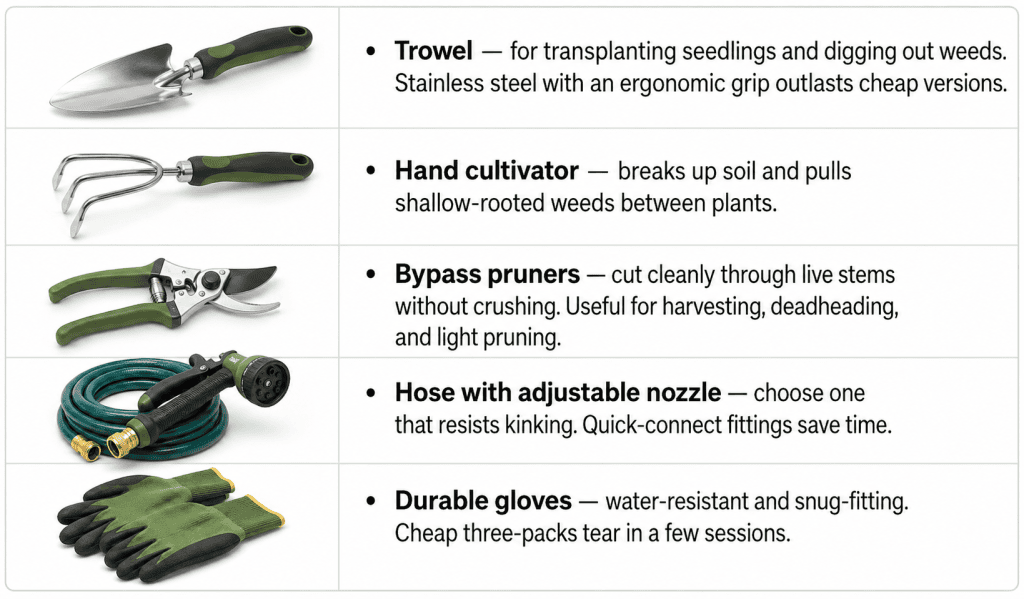
Your core hand tools handle most daily tasks in a vegetable garden. A trowel ranks as your first purchase. You’ll use it to transplant seedlings, break up roots and dig deep-rooted weeds. Select one with an ergonomic design that prevents wrist pain during extended use. Stainless steel construction with a comfortable grip outlasts cheap alternatives.

Hand forks or cultivators break up soil in spring and control small weeds. They also pull stubborn roots from below the surface. Choose metal tines with a solid handle that won’t bend under pressure. Garden shears or bypass pruners serve multiple purposes: harvesting vegetables, deadheading flowers and pruning. Bypass-style pruners cut cleanly through live plant tissue without crushing stems, unlike anvil pruners designed for dead wood.

Specialized weeders like the Korean EZ-digger uproot dandelions and other tap-rooted plants through their claw-like head design. Harvest knives, Hori Hori knives with sharp steel blades in particular, cut lettuce heads and herbs while doubling as digging tools for stubborn weeds.

Larger digging tools become necessary once your garden exceeds a few raised beds. Shovels feature longer handles with curved blades and work well to move soil and compost. Spades offer shorter handles with straight, sharp blades designed to dig, cut and edge. You don’t need both unless you’re doing extensive work that requires precise edges. Garden forks turn compost piles and aerate soil. They also dig root vegetables like carrots and beets without damaging them.

Hoes speed up weeding between plants. Wire hoes with interchangeable heads accommodate varying plant spacing, while traditional hoes dig trenches and remove large weeds after rain loosens soil.

Watering equipment requires durability over appearance. Choose hoses that resist kinking, store compactly and match your garden’s dimensions. Quick-connect fittings extend reach without wrestling multiple hose sections. Skip all-plastic watering wands that crack with frequent use. Metal or reinforced options with various handle lengths save your back when reaching distant plants. Keep spare gaskets and silicone tape on hand to extend equipment life. Watering cans need balanced weight distribution when full. Metal cans resist rust through galvanization, while quality plastic versions weigh less but deteriorate faster.

Invest in durable gloves instead of cheap three-packs that tear within weeks. Research options made from water-resistant, breathable materials that fit snugly without restricting movement. Wash them occasionally to extend their lifespan beyond one season.

Quality matters more than quantity. Select tools with steel or aluminum construction and ergonomic rubber or wooden handles. They should have sturdy weight. Bargain bins stock poorly made tools that break during normal use and cost you replacement money. Gardening stresses equipment, so durability saves cash long-term.

Soil and Compost Supplies

Compost transforms mediocre soil into productive growing medium. Bagged compost costs USD 0.30 to USD 20.00+ per 10 pounds. Bulk compost costs USD 10.00 to USD 150.00+ per cubic yard, with bulk purchases delivering much better value than bags. To name just one example, bulk compost at USD 259.00 for 2 cubic yards breaks down to less per cubic foot than individual bags.

Quality compost smells earthy, not like ammonia or garbage. Ammonia odor indicates incomplete decomposition. Look for dark, moist, fluffy texture that resembles finished soil. Ingredients should include combinations of leaves, grass clippings, plant trimmings and food scraps. Avoid products listing tree bark as the primary ingredient, as it provides minimal nutrition and contains growth-inhibiting compounds.

Apply 1 to 2 inches of compost yearly to prevent soil depletion, though 2 to 4 inches builds soil structure more effectively. One part compost to two parts existing soil provides adequate amendment for most gardens. Calculate your bed dimensions to determine cubic yards needed before purchasing.

Making your own compost reduces costs while recycling yard waste. Collect fruit and vegetable peels, coffee grounds, eggshells and dry leaves in a bin or tumbler. Layer browns (carbon-rich materials like dry leaves) and greens (nitrogen-rich materials like food scraps) at a ratio of two to three parts browns to one part greens. Keep materials damp like a wrung-out sponge and turn occasionally with a garden fork. Finished compost develops within three to five months.

Optional Equipment That Makes Life Easier

Plant supports prevent sprawling vegetables from rotting on wet ground. Bamboo stakes, T-posts and cages last multiple seasons without expensive gadgets. Trellis netting works vertically to support cucumbers and peas or horizontally to support heavy fruits. Secure everything with jute twine or zip ties.

Store tools vertically on hooks and racks in sheds or against greenhouse walls. This protects tools from weather while keeping them within reach.

Skip these items in year one: flame weeders, mechanical seeders and tillers (use a broadfork instead). Also skip moisture meters, pH testers and landscape fabric. Focus on soil quality before investing in specialized equipment.

Clean cutting tools after each use by brushing off debris and wiping dry. Spray with disinfectant, rinse and dry again. You can oil spring mechanisms optionally. This five-minute routine extends tool life by a lot. Perform deeper cleaning and oiling at season’s end.

How to Choose the Perfect Garden Location

Location determines whether your vegetables thrive or struggle through the season. Before you buy seeds or build beds, spend time observing how sunlight moves across your yard and where water flows.

Finding the Sunniest Spot in Your Yard

Most vegetables require six hours of direct sunlight each day. Plants needing partial sun or shade do fine with three to six hours, while full shade plants tolerate up to three hours of light per day. Observation beats guessing. Track sun exposure at specific intervals like 9 a.m., noon, and 4 p.m. on a cloudless day. Record which areas stay sunny versus those that slip into shade as the sun moves.

Do this sun survey in early to mid-spring when trees begin leafing out. Bare branches allow more light than full canopies, so spring observations show realistic summer conditions. Draw your yard’s outline on paper and mark circles depicting sunny areas at each time interval. Where these circles overlap indicates your sunniest spots.

Large trees, shrubs, and structures cast shadows that shift throughout the day. Areas appearing sunny at 10 a.m. might fall into shade by 2 p.m. as the sun climbs higher. Trees provide even more shade once they develop full foliage than during your first observations. Note these patterns before committing to a location.

Water Access and Drainage Requirements

You’ll drag hoses across your yard each week, and that gets frustrating fast. Position gardens near outdoor faucets or within easy hose reach. Watering is one of your most frequent tasks, so convenience matters over time.

Avoid low spots where water pools after rain. Standing water suffocates roots and creates muddy conditions that prevent garden access. Walk your yard following heavy rainfall to identify drainage problems. Compacted or clay-heavy soil drains poorly, while sandy soil drains too fast. You’ll need to improve soil structure through amendments before planting.

Measuring and Mapping Your Space

Start by sketching your yard’s rough outline in a notebook. Include your house, fences, trees, existing beds, and any permanent features. Use a measuring tape to record dimensions and work from a fixed reference point like a house wall or fence that won’t move.

Transfer measurements to graph paper using an appropriate scale. One square equals one foot works for small yards. Larger properties need compressed scales like one inch representing four feet. Measure tree trunk locations plus their canopy spread by walking across from one edge to the opposite side. This shows shade zones for plant selection.

Create overlay sheets using tracing paper taped over your base map. Mark sun and shade patterns, drainage flow, and planned garden locations on separate overlays. This technique lets you test different layouts without redrawing everything.

North vs South Facing Gardens

Stand with your back against your house wall holding a compass. The direction it points shows your garden’s orientation. South-facing locations receive the most sunlight throughout the day and are ideal for sun-loving vegetables. Southwest is a close second option.

North-facing gardens get the least direct light. Soil stays cooler and takes longer to warm in spring. Moisture and moss become common issues. But these spots work well for leafy greens, root vegetables, and brassicas like broccoli and cauliflower.

East-facing areas catch morning sun but shift to afternoon shade. This protects plants from harsh afternoon rays while providing adequate light. West-facing gardens experience opposite patterns with intense afternoon sun exposure. Match crops to available light and any orientation produces food with proper plant selection.

Step-by-Step Guide to Starting Your First Garden

Transforming an empty yard space into a productive garden follows a logical sequence. Each step builds on the previous one, so rushing ahead creates problems later.

Step 1: Clear and Prepare Your Garden Area

You can remove existing grass using one of three methods. Smothering grass with 6 to 8 sheets of newspaper or 1 to 2 layers of cardboard kills grass within several months and adds organic matter. Cover with 3 to 4 inches of compost to hold materials down. Manual sod removal with a sharp spade provides immediate results but requires you to remove strips 1 foot square at roughly 1 inch depth. Tilling works when you need a quick turnaround but brings dormant weed seeds to the surface and disrupts soil structure.

Step 2: Build or Install Raised Beds (or Choose Containers)

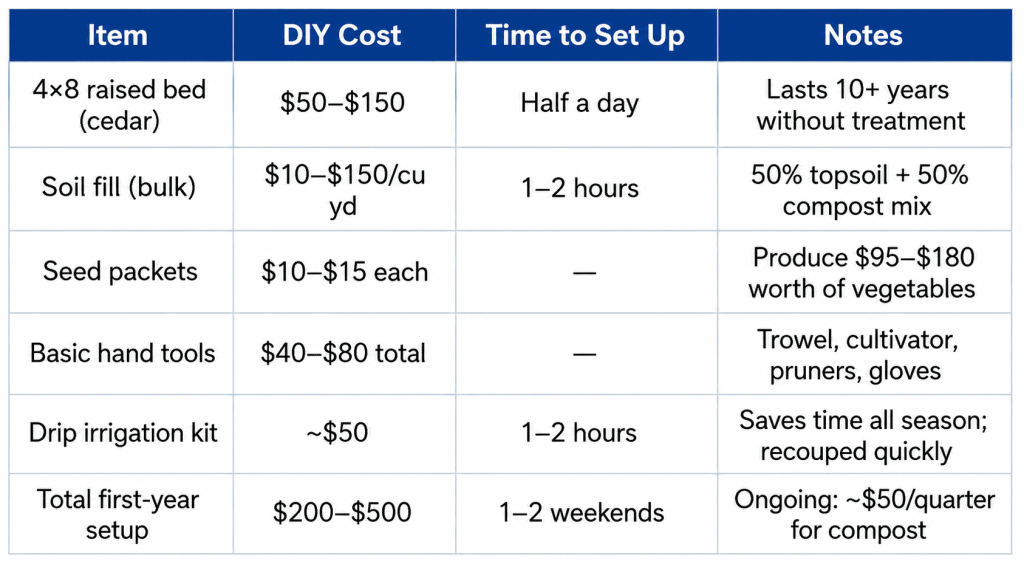
Standard raised beds measure 4 feet wide by 8 feet long and allow you to reach the center from either side without stepping on soil. Height should be 6 inches minimum, though 16 to 18 inches provides better drainage. Cedar boards 2 inches thick resist rot without chemical treatment. Material costs run around USD 50 to USD 150 per bed depending on size. Containers work where no ground soil exists but require more frequent watering.

Step 3: Fill with Quality Soil Mix

You should mix 50 percent topsoil with 50 percent compost in simple raised beds. Containers need 50 percent topsoil, 25 percent coarse sand and 25 percent compost. Calculate cubic feet by multiplying length times width times height, then divide by 27 to get cubic yards needed. Budget USD 10 to USD 150 per cubic yard when ordering bulk soil delivery.

Step 4: Select Your First Plants Based on Your Zone

Your USDA hardiness zone determines which plants survive winter in your area. Plant tags show zone ranges you need to check. A plant that lists zones 4 to 8 will survive if you’re in zone 5. Container plants need zones two levels lower than ground plants due to colder root temperatures.

Step 5: Plant at the Right Depth and Spacing

Tomatoes need 24 to 36 inches between plants. Lettuce requires just 3 inches. Plant beans 1 to 2 inches deep with 2 to 4 inches spacing. Carrots go 1/4 to 1/2 inch deep, 1 to 3 inches apart. Proper spacing increases production by 40 percent and reduces competition.

Step 6: Set Up Your Watering System

Drip irrigation costs around USD 50 at first but saves time all season. You’ll need a pressure regulator, timer and 1/4-inch tubing with emitters spaced at plant bases. Soaker hoses cost less but work only on flat ground up to 200 feet. Water 75 minutes two to three times weekly in summer.

Step 7: Add Mulch and Protection

You should apply 2 to 4 inches of mulch after planting. Straw works well with vegetables and wood chips with perennials. Keep mulch 2 inches away from plant stems to prevent rot. Row covers and netting over beds provide pest protection. Neem oil treatments help control soil pests when applied the right way, but improper use burns leaves.

Common Beginner Mistakes and How to Fix Them

Close-up of hands planting young seedlings in soil, highlighting beginner gardening activities for summer.

Image Source: Epic Gardening

“There are no gardening mistakes, only experiments.” — Janet Kilburn Phillips, Gardening author and expert

New gardeners repeat the same errors season after season. When you recognize these patterns now, you save months of frustration.

Starting Too Big Too Fast

A 10×10 foot garden produces plenty of food for beginners while remaining manageable. Many gardeners dig 20×20 plots that become overtaken by weeds and neglect. Constraint drives success. Commit to 5 to 10 plant species your first season rather than attempting everything at once. You’ll find expanding next year proves easier than abandoning an overwhelming space mid-season.

Poor Soil Preparation

When you skip soil tests, poor plant growth results despite your best efforts. Test your soil’s pH and nutrient levels before planting. Amend with compost or well-rotted manure based on test results. Plants need quality soil structure. Clay soil drowns roots. Sandy soil drains too fast and loses nutrients.

Wrong Plant Choices for Your Climate

Hardiness zones indicate winter survival but ignore growing season length and heat tolerance. Athens, GA gardeners get 200+ growing days while Springfield, MA gardeners receive only 145 days. Match varieties to your specific conditions. Heat-tolerant lettuces like ‘Black-seeded Simpson’ handle temperatures that cause standard varieties to bolt.

Overwatering or Underwatering

Check soil moisture by sticking your finger 1 inch below the surface. Water if dry. Wait if moist. Daily watering drowns roots and encourages disease. Water deeply once weekly in dry weather instead. Morning watering between 5 to 9 a.m. allows foliage to dry fast and prevents fungal growth.

Realistic Cost, Time, and Skill Requirements

Raised vegetable garden bed with tomato plants supported by stakes, lettuce, and marigold flowers growing in a backyard.

Image Source: Farmer’s Almanac

Building your first garden costs less than most homeowners think when starting from scratch. For DIY raised beds, budget USD 25 to USD 50 per square foot for wood construction. A simple 4×4 foot raised bed runs around USD 435, while container setups start at USD 190 for two planting boxes. One documented first-year garden required USD 741.56 in total investment including tools and soil and that electric chipper. Turnkey professional installations cost USD 100+ per square foot but eliminate setup work. Ongoing expenses include quarterly compost additions at USD 50 per application for six beds.

Budget Breakdown for a Beginner Garden

A starter vegetable garden will cost USD 200 to USD 500 when you handle installation yourself. Professional design and installation multiplies costs but suits homeowners who lack time or physical capability.

How Much Time to Expect Weekly

Survey data shows 2 to 3 hours weekly ranks as the most common time investment. The practical formula suggests 1 to 3 minutes per square foot of growing space each week. Gardens that are established average 2 hours weekly during peak season.

Skill Level Needed (Spoiler: Very Little)

Gardening requires minimal expertise to start. Simple competency develops within several months to a year of practice.

When to Think About Hiring Help

Review your budget, project scope and timeline before hiring. Physical limitations, time constraints or complex projects justify professional assistance.

Conclusion

You now have everything needed to start your first garden this season. Begin with a small 4×4 or 4×8 raised bed, invest USD 200 to USD 500 in simple supplies, and commit 2 to 3 hours weekly to maintain it.

Your first garden won’t be perfect, and that’s fine. You’ll overwater some plants or battle unexpected pests. Each mistake teaches you something valuable for next season.

Start with five easy crops suited to your climate, test your soil before planting, and skip the fancy equipment until year two. Consistency matters more than perfection when building gardening skills.

Pick your sunniest spot, clear the ground this weekend, and get those first seeds in the soil.

FAQs

Q1. How do I start a garden if I have no prior experience? Begin by selecting a sunny location in your yard and starting small with a 4×4 or 4×8 foot raised bed. Choose 5 easy-to-grow vegetables suited to your climate, invest in basic tools like a trowel and hand fork, and prepare quality soil with compost. Test your soil before planting, water consistently, and expect to spend 2-3 hours weekly on maintenance. Starting small allows you to learn without becoming overwhelmed.

Q2. What basic tools do I need to start my first garden? Essential tools include a trowel for transplanting, hand fork for weeding, bypass pruners for harvesting, a shovel or spade for digging, and a quality hose with watering wand. You’ll also need durable gloves and containers for collecting weeds. Skip specialized equipment like tillers and moisture meters in your first year—focus on these core tools that handle most daily gardening tasks.

Q3. How much does it cost to start a beginner vegetable garden? Expect to spend USD 200 to USD 500 for a DIY starter garden. This includes materials for a raised bed (around USD 50-150), quality soil and compost (USD 10-150 per cubic yard), seeds or seedlings, and basic tools. A 4×4 foot raised bed typically costs around USD 435 to build and fill. Professional installation increases costs significantly but may be worth considering if you have physical limitations or time constraints.

Q4. How much sunlight does my garden need to be successful? Most vegetables require at least 6 hours of direct sunlight daily to thrive. Observe your yard throughout the day in early to mid-spring to identify the sunniest spots, tracking sun exposure at 9 a.m., noon, and 4 p.m. South-facing locations receive the most sunlight, while north-facing areas work better for leafy greens and shade-tolerant crops. Proper sun exposure is one of the most critical factors for garden success.

Q5. What are the most common mistakes new gardeners make? The biggest mistakes include starting with too large a garden space, skipping soil testing and preparation, choosing plants unsuitable for your climate zone, and overwatering. Many beginners also plant too densely, which reduces yields by up to 40%. Start with a manageable 10×10 foot space or smaller, test your soil’s pH and nutrients before planting, and check soil moisture before watering rather than following a daily schedule.

📬 Subscribe to DecorModern newsletter

We don’t spam! Read more in our privacy policy

Scroll to Top