
In this guide
This article helps you catch problems early, skip unnecessary service calls, and make better decisions when a technician gives you options.
Why HVAC Knowledge Saves You Money
Your HVAC system accounts for about 50% of total home energy consumption—more than any other system in the house. That makes it the biggest lever on your monthly utility bill and the most expensive thing to replace when it fails.
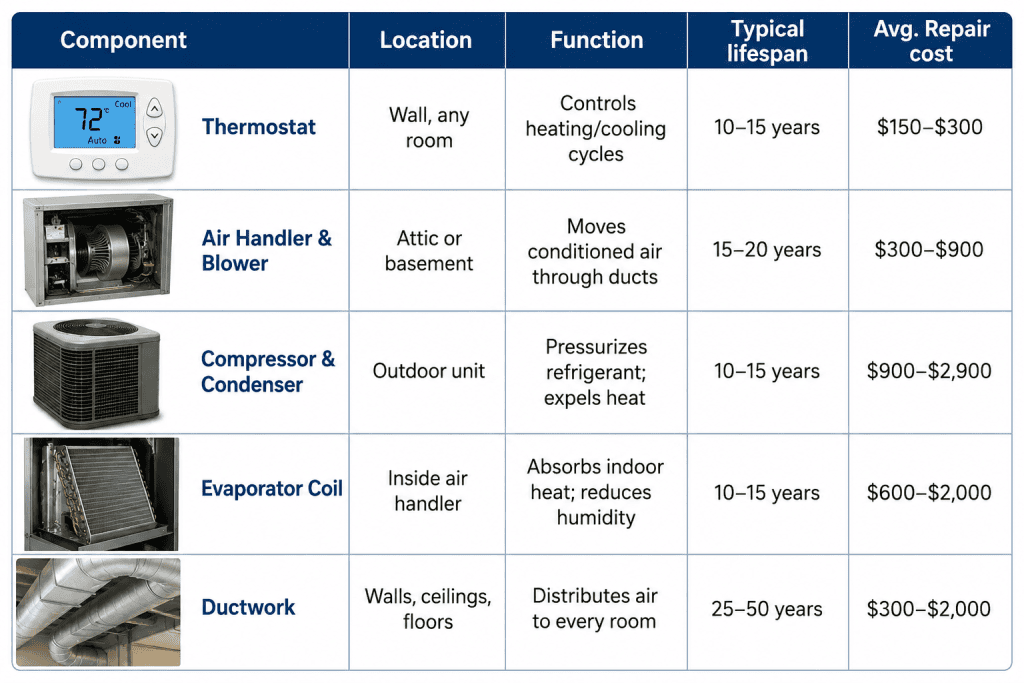
A new central air conditioner runs $3,000–$7,500. A furnace replacement can reach $3,500 or more. A blower motor alone costs $300–$900. None of those come with advance warning. But most failures give you warning signs weeks before they become emergencies—if you know what to look for.
Simple maintenance tasks prevent most of the expensive calls. Knowing when to do those things—and when to stop and call a professional—is the practical value of understanding your system.
The Six Key Components
- Thermostat. It monitors room temperature and tells the system when to run. Manual thermostats use a dial; programmable models run schedules; Wi-Fi thermostats connect to your phone and can adjust settings automatically based on occupancy or time of day.
- Air Handler and blower. This one lives in the attic, basement, or utility closet. It has the blower fan, air filter, and evaporator coil inside. The blower draws return air from the rooms, runs it over the evaporator coil, and pushes the conditioned air back through the ducts.
- Compressor and condenser. The outdoor unit runs the compression side of the cycle: the compressor pushes refrigerant into a high-pressure, high-temperature gas, which then flows through the condenser coil and releases its heat into the outside air. Of all the components, the compressor is the costliest to replace.
- Evaporator coil. It sits inside the air handler and is the point where the cooling takes place. Warm air passes over the cold coil, the refrigerant pulls the heat out, and water vapor condenses on the coil surface and drains outside — that condensation is what drops indoor humidity alongside the temperature.
- Ductwork. Supply ducts carry conditioned air from the air handler to each room through registers in the floor, walls, or ceiling. Return ducts pull air back to the system for reconditioning. Ducts closest to the air handler receive the most airflow; rooms at the far ends of the run often run warmer or cooler as a result. Leaky ductwork can add 20–30% to energy bills—the conditioned air is literally escaping into wall cavities before it reaches the room.
- Refrigerant. It transfers heat by cycling between liquid and gas states. Refrigerant work requires EPA Section 608 certification—it’s not a DIY task, and adding refrigerant without fixing an underlying leak is a short-term fix at best.
Cooling Cycle
When your home gets warmer than the thermostat setting, the system pulls in warm air, cools it over the evaporator coil, and sends it back through the house. The refrigerant carries the heat to the outdoor unit, where it’s released outside. This cycle repeats until the desired temperature is reached.
The blower runs continuously throughout. The compressor and condenser fan only run when the system is actively cooling—short, frequent on-off cycles (called short cycling) indicate a problem, usually with refrigerant charge, a dirty coil, or an oversized system.
Heating Cycle
Gas furnaces run a specific startup sequence. The inducer motor clears residual gas and pulls in fresh combustion air. The ignitor lights the burners, which heat a metal heat exchanger. The blower then pulls air over that exchanger and pushes it through the ducts. When the thermostat hits your target, the system shuts off and waits for the temperature to drop again.
Heat pumps work differently. Instead of generating heat, they extract it from outdoor air and move it inside—even in cold weather, there’s enough heat in the air to do this down to around 35–40°F. Below that, most systems switch to electric backup heat strips. Heat pumps are more efficient than furnaces in moderate climates (they can deliver over 100% efficiency in BTU terms), but they struggle in sustained hard freezes. Furnaces are more consistent in colder regions and last longer—20+ years versus 15 for heat pumps—but cost more to run when fuel prices are high.
Warning Signs

Noises
- Banging/clanking: loose parts, a broken blower blade, or a failing motor.
- Squealing: worn belt or dry motor bearings—usually caught before failure.
- Clicking that doesn’t stop: a faulty relay or control board.
- Hissing: refrigerant leak or air escaping from ductwork.
Performance
- Inconsistent temperatures room to room: ductwork leaks or an undersized unit.
- The system runs constantly without hitting the set temperature: low refrigerant, dirty coil, or an undersized unit.
- Weak airflow from registers: clogged filter, failing blower, or blocked duct.
- Humidity feels off: coil icing over, blocked condensate drain, or thermostat fan set to “on” instead of “auto”.
Smells
- Musty or moldy: moisture in the ductwork or a blocked condensate drain.
- Burning: electrical issue—shut the system off and call a technician.
- Rotten egg: gas leak—exit the house and call the gas company immediately.
Cases For a DIY
- Replace air filters every 1–3 months or monthly if you have pets or a dusty home, every 90 days if it’s just you in a clean space.
- Check the thermostat first. Dead batteries, wrong mode settings, or a tripped circuit breaker cause a surprising number of “my system isn’t working” calls.
- Maintain the outdoor unit clearance. Allow at least 2 feet of clearance around the condenser.
- Check all vents are open. Closing vents to “redirect” airflow actually increases static pressure and stresses the system. Leave them open.
- Clear the condensate drain line. A wet/dry vac on the drain outlet clears most clogs.
Time to Call a Pro
Some issues need a licensed technician:
- Refrigerant leaks.
- Heat exchanger cracks.
- Electrical component failures.
- Compressor failure.
Repair&Maintenance Costs
Conclusion
The system does one thing: pull air in, condition it, push it back out. All the elements have predictable failure modes and warning signs. Filters, thermostat batteries, keep outdoor units free of debris, and open vents—those are on you, and staying on top of them prevents most of the expensive service calls.
Sources
Every external claim in this guide links to its origin. Collected automatically from the text above.
- about 50% — sciencedirect.com
- $3,000–$7,500 — pickcomfort.com
- $300–$900 — pickhvac.com
- 20–30% — energystar.gov
- 20+ years — carrier.com
- 15 — trane.com
- every 1–3 months — carrier.com

Nina Kowalski
Nina covers flooring, renovation planning, and DIY repair guides for Decor Modern. Her focus is translating contractor-level knowledge into step-by-step instructions that a homeowner can actually follow on a Saturday morning. Before writing about home improvement, Nina spent four years managing renovation projects for residential properties in the Midwest — coordinating work between flooring installers, painters, and general contractors. She worked on projects ranging from single-room updates to full-home renovations, gaining firsthand experience in budgeting, timelines, and contractor coordination. That experience taught her which shortcuts work, which ones backfire, and how much things really cost when the estimate meets reality. She saw how initial estimates change once work begins — and which decisions tend to increase costs or cause delays. Her most-read articles on Decor Modern include a guide to fixing scratches on hardwood floors and a breakdown of the cost to refinish hardwood floors. She also writes the site's cost comparison pieces, where she digs into real pricing data rather than repeating vague national averages. Her writing is grounded in real project constraints — including labor availability, material costs, and unexpected issues that arise during renovation. Nina holds a degree in Communications and has contributed home improvement content to several online publications. She lives in Ohio, where she is currently refinishing the original oak floors in a 1948 Cape Cod — one room at a time.