

In this guide
Picking between a deck and a patio isn’t really about taste—it’s about what your yard will let you build without draining your wallet. Get it backwards and you’ll either spend thousands grading a sloped lot for a patio, or pour money into deck upkeep you never wanted.
What’s the Difference?
A deck is basically a platform raised up on posts and beams — sometimes just a step off the lawn, sometimes climbing several stories if you’re building into a hillside. Most get bolted to the house through a ledger board, though a lot of people skip that and build freestanding on their own footings instead, especially if they don’t want to deal with cutting into the siding. Material-wise, pressure-treated lumber is the cheap, no-frills route, composite and PVC sit in the middle, and real wood like cedar or ipe looks the best but comes with the most maintenance.
A patio doesn’t bother with any of that. It’s a hard surface — concrete, pavers, brick, stone — sitting straight on the ground, shaped to whatever grade your yard already has. No posts, no railings, no staircase to build.
The split comes down to terrain and upkeep. Decks shrug off slopes because support posts adjust to whatever height the ground demands. Patios need flat or graded land. On maintenance, a concrete patio can run 25+ years with little more than an occasional power wash, while a wood deck wants to be restained every couple of years or it starts looking rough.
Weighing the Pros and Cons
Decks make sense on sloped lots, where adjustable posts skip the grading costs a patio would need. There’s a resale angle too: per Zonda’s 2025 Cost vs. Value Report, a wood deck addition recoups roughly 95% of its cost at resale nationally, and composite recoups around 89%. The tradeoff is upkeep—wood needs staining every one to two years, and the frame underneath still needs periodic checks for rot regardless of decking material.
Patios win on price and lifespan. A basic concrete slab runs about $3–$10 per square foot installed. Pavers and natural stone run $15–$50 per square foot, trading cost for durability. Upkeep is just sweeping and an occasional reseal. The catch is terrain—sloped or clay-heavy yards need real excavation first, and freeze-thaw cycles in cold climates can shift pavers if the base wasn’t built right.
What It Actually Costs in 2026
Decks run $15–$60 per square foot installed, with most projects landing between $4,339 and $12,633. Pressure-treated wood is the budget option at $15–$25 per square foot; composite decking runs $25–$54 per square foot but skips the staining cycle.
Patios cost less. A basic concrete patio averages around $3,200 for roughly 280 square feet, about $11 per square foot. Paver patios run $15–$30 per square foot installed, with a typical mid-size project landing around $3,800–$4,000 total.
Labor eats roughly half the budget either way. Decks over 30 inches above grade usually need a permit, often $100–$500; patios rarely need one at all.
Lifespan: Patios Pull Ahead
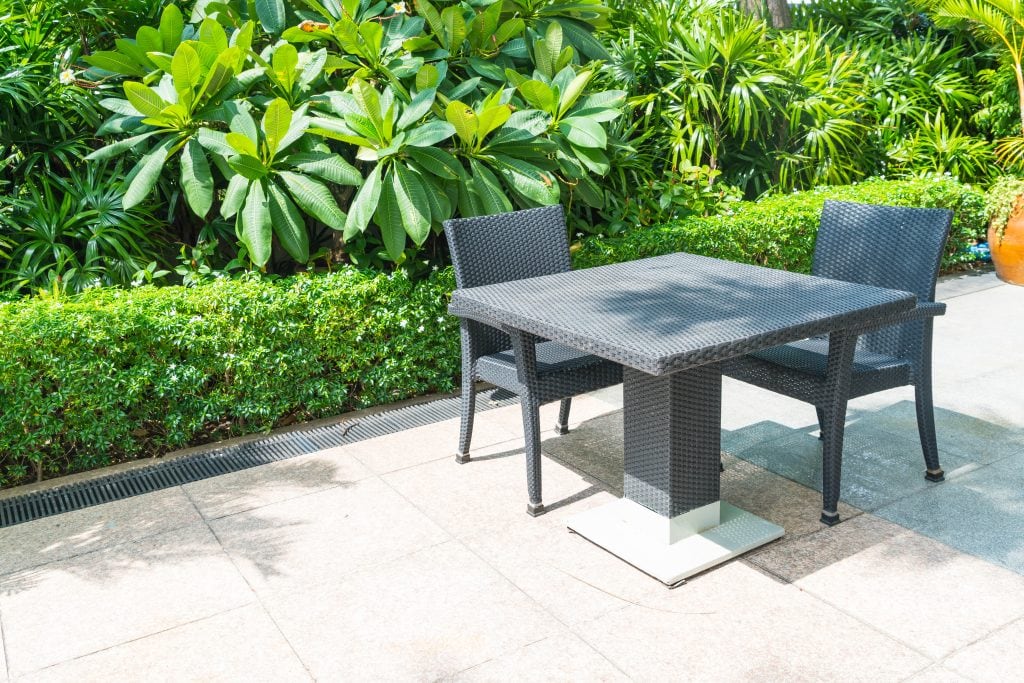
Pressure-treated wood decks typically last 10–15 years before major boards need swapping, though composite and PVC stretch that to 25–50 years. Concrete patios commonly last 25–50 years, and natural stone can outlast that by decades when installed correctly. Over a 20-year span, a wood deck’s restaining cycle adds up—patios mostly skip that math, which is why they stay the lower-maintenance pick even with a smaller resale bump.
How to Decide
- Slope: Real grade favors a deck—posts handle uneven terrain without costly excavation.
- Soil: Clay can crack a poorly prepped patio; sandy soil suits patios without extra treatment.
- Maintenance tolerance: Go composite or patio to skip staining duty; wood only if you don’t mind the upkeep.
- Privacy vs. views: Patios screen easily at ground level; decks offer elevation but more exposure.
- Permits: Decks over 30 inches need permits and inspections; patios usually don’t.
Quick Comparison
| Factor | Deck | Patio |
| Average cost (2026) | $4,339 and $12,633 | ~$3,800–$4,000 |
| Cost per sq ft | $30–$60 installed | $15–$30 installed |
| Best terrain | Sloped or uneven | Flat or graded |
| Lifespan | 10–50 years by material | 25–50+ years |
| Maintenance | Staining every 1–2 yrs (wood) | Occasional cleaning/sealing |
| Resale ROI | ~89–95% | Lower, but cheaper upfront |
| Permit needed | Usually, over 30 inches | Rarely |
Bottom Line
If your yard slopes or you’re chasing resale value, a deck earns its higher price tag. If you’ve got flat ground and want something durable that asks little of you afterward, a patio is the smarter spend. Either way, get a couple of contractor quotes before committing—site conditions move the final number more than any general price guide ever will.
Sources
Every external claim in this guide links to its origin. Collected automatically from the text above.
- Zonda's 2025 Cost vs. Value Report — zondahome.com
- $3–$10 — concretenetwork.com
- $15–$50 — bhumicalculator.com
- $15–$60 — angi.com
- $3,800–$4,000 — angi.com
- 10–15 years — hammerio.com
- need permits — angi.com
- ~89–95% — nari.org

Nina Kowalski
Nina covers flooring, renovation planning, and DIY repair guides for Decor Modern. Her focus is translating contractor-level knowledge into step-by-step instructions that a homeowner can actually follow on a Saturday morning. Before writing about home improvement, Nina spent four years managing renovation projects for residential properties in the Midwest — coordinating work between flooring installers, painters, and general contractors. She worked on projects ranging from single-room updates to full-home renovations, gaining firsthand experience in budgeting, timelines, and contractor coordination. That experience taught her which shortcuts work, which ones backfire, and how much things really cost when the estimate meets reality. She saw how initial estimates change once work begins — and which decisions tend to increase costs or cause delays. Her most-read articles on Decor Modern include a guide to fixing scratches on hardwood floors and a breakdown of the cost to refinish hardwood floors. She also writes the site's cost comparison pieces, where she digs into real pricing data rather than repeating vague national averages. Her writing is grounded in real project constraints — including labor availability, material costs, and unexpected issues that arise during renovation. Nina holds a degree in Communications and has contributed home improvement content to several online publications. She lives in Ohio, where she is currently refinishing the original oak floors in a 1948 Cape Cod — one room at a time.