

In this guide
Most homeowners interact with their electrical system dozens of times a day without knowing how it works. That’s fine until something trips, sparks, or stops working—then it matters. Understanding the basic path electricity travels through your home, what each component does, and which problems require a licensed electrician helps you respond correctly instead of guessing.
How Electricity Gets to Your House
Power plants generate electricity and push it through the transmission system at very high voltages—115,000 to 500,000 volts—across thousands of miles of transmission lines. High voltage reduces energy loss over distance. Substations step that down to distribution levels (typically 13,200–25,000 volts), which travel along the lines you see along roads. A transformer on the utility pole near your home does the final step-down, reducing voltage to 120/240 volts—what your appliances actually use.
The wires running from that transformer to your home are called the service drop. They connect to the service mast—a vertical pipe on the exterior—which feeds into your electric meter. The meter tracks consumption in kilowatt-hours and marks the boundary between utility responsibility and yours. Everything past the meter is your system to maintain.
The service drop forms a drip loop as it enters the mast—a deliberate downward curve that keeps water from running along the wires into the service entrance. Service wires also need at least 3 feet of clearance above roof surfaces; trees growing into that space are a common cause of service disruptions.
The Service Panel
The main service panel (breaker box) receives power from the meter and routes it to every circuit in the house. Residential panels are rated at 100 or 200 amps. Homes built before 1990 frequently have 100-amp panels, which were adequate for that era but struggle with modern loads—EV chargers, central air, and electric appliances add up fast. A 200-amp panel is standard in new construction and required for most panel upgrades today.
What’s Inside
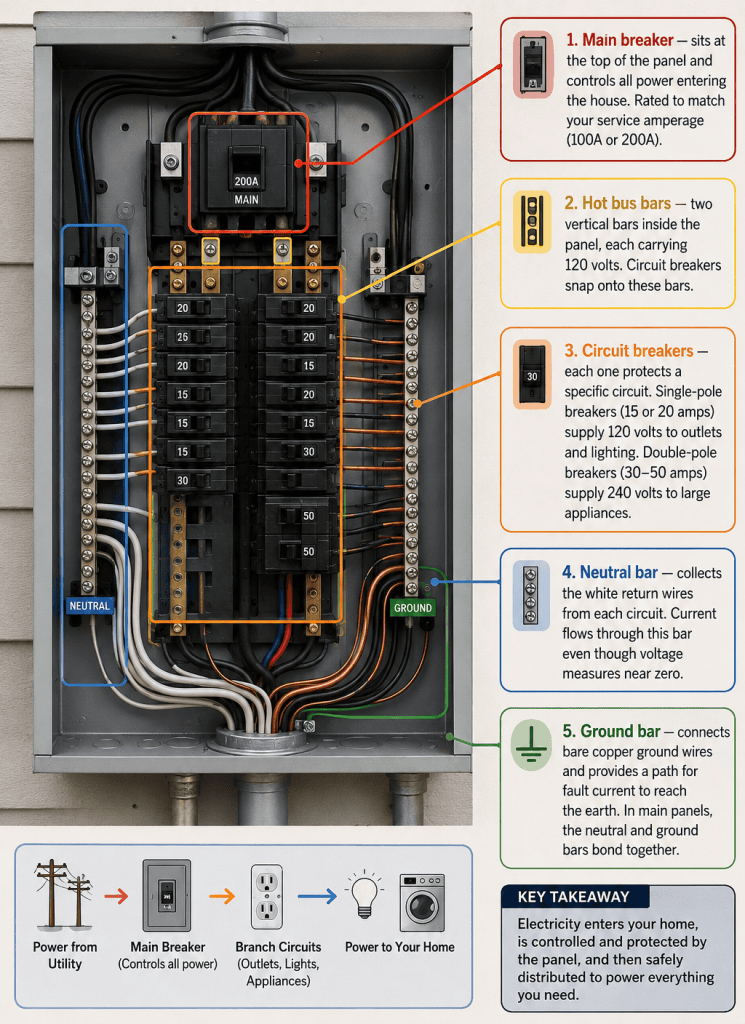
How Circuit Breakers Work
Inside each breaker is a bimetallic strip—two metals bonded together that expand at different rates when heated. When current exceeds the breaker’s rating, the strip heats up, bends, and trips the switch, cutting power to the circuit. For short circuits, an electromagnetic coil reacts faster, tripping the breaker almost instantly. This is what prevents overloaded wires from overheating and starting fires.
Branch Circuits
Branch circuits are the individual pathways that carry power from the panel to specific parts of the house. Each circuit has three wires: a hot wire (black, carrying voltage), a neutral wire (white, completing the return path), and a ground wire (bare copper or green, for fault protection).
120-Volt vs. 240-Volt Circuits
A 120-volt circuit connects to one hot bus bar and the neutral bar. Standard outlets and lighting run on these—typically 15-amp breakers with 14-gauge wire or 20-amp breakers with 12-gauge wire. A 240-volt circuit connects to both hot bus bars, doubling the voltage. Electric ranges, dryers, water heaters, and central air conditioners all need 240-volt service, usually on 30–50 amp breakers with 10-gauge or 6-gauge wire.
Dedicated Circuits
Some appliances need a circuit to themselves. The National Electrical Code requires dedicated circuits for refrigerators, dishwashers, washing machines, microwaves over 1,000 watts, and HVAC systems. Plugging a high-draw appliance into a shared circuit creates the kind of repeated tripping that eventually damages wiring.
GFCI and AFCI Protection
Ground Fault Circuit Interrupter (GFCI) outlets detect when current is leaking outside its intended path—like through a person—and cut power in about 1/40 of a second. Required by code in bathrooms, kitchens, garages, outdoor locations, and anywhere near water. If an outlet near a sink has no power, a tripped GFCI is the first place to check: they have test and reset buttons on the face.
Arc Fault Circuit Interrupter (AFCI) breakers detect the specific electrical signature of arcing—the kind that happens inside walls from damaged or loose wiring—and trip before it can ignite surrounding material. Required in bedrooms in most jurisdictions under current NEC code and increasingly required throughout living areas. Standard breakers don’t detect arcing; AFCIs do.
When Something Feels Off
| Problem | Likely cause | DIY or pro | Action |
| Tripped breaker (once) | Temporary overload | DIY | Reset; reduce load on circuit |
| Breaker trips repeatedly | Overloaded circuit or short | Pro | Call electrician—don’t just reset |
| Flickering lights | Loose connection or overload | Pro | If new bulb doesn’t fix it, call pro |
| Warm or sparking outlet | Failing wiring or overload | Pro | Stop using; call electrician |
| Burning smell from panel/outlet | Overheating wire or arc fault | Pro immediately | Turn off power; call electrician now |
| Buzzing from switch or panel | Arcing or failing component | Pro | Don’t ignore—fire risk |
| No power to outlet | Tripped GFCI or breaker | DIY first | Reset GFCI; check panel |
In 2021, electrical fires caused 24,200 residential building fires—295 deaths, 900 injuries, and over $1.2 billion in property losses. A burning smell, a warm outlet, a breaker that keeps tripping—those aren’t minor nuisances. They’re the system warning you before something fails completely.
What You Can Handle vs. When to Call a Pro
Reasonable DIY
- Resetting a tripped breaker—switch it fully off first, then back on.
- Resetting a tripped GFCI—press the reset button on the outlet face.
- Replacing a standard outlet or switch—with power off at the breaker, confirmed with a non-contact tester.
- Installing a ceiling fan where a fixture already exists—same wire count, no new circuit needed.
Call a Licensed Electrician
- Any new circuit—requires panel work and permits.
- Panel upgrades—100A to 200A conversions involve the service entrance.
- Aluminum wiring—requires specific techniques and connectors not covered by general electrical knowledge.
- Permits and inspections—required for most significant electrical work; skipping them voids homeowner’s insurance coverage for related claims and creates disclosure problems at resale.
Service calls typically run $150–$300. That’s the cost of getting it done correctly. The cost of fixing improperly done electrical work—or dealing with fire damage—is a different number entirely.
Bottom Line
Electricity enters through the service drop, passes through the meter, and routes to circuits through the service panel. Each breaker protects one circuit; GFCI and AFCI devices add layers of protection at the outlet and panel level. Resetting breakers and GFCIs is straightforward. Anything involving new wiring, panel work, or burning smells needs a licensed electrician—not because the work is impossible, but because the consequences of getting it wrong are serious enough that the permit and inspection process exists for a reason.
Sources
Every external claim in this guide links to its origin. Collected automatically from the text above.
- 115,000 to 500,000 volts — eia.gov
- Residential panels are rated at 100 or 200 amps — mistersparky.com
- The National Electrical Code requires dedicated circuits — astardfw.com
- In 2021, electrical fires caused 24,200 residential building fires — usfa.fema.gov
- $150–$300 — mistersparky.com

Nina Kowalski
Nina covers flooring, renovation planning, and DIY repair guides for Decor Modern. Her focus is translating contractor-level knowledge into step-by-step instructions that a homeowner can actually follow on a Saturday morning. Before writing about home improvement, Nina spent four years managing renovation projects for residential properties in the Midwest — coordinating work between flooring installers, painters, and general contractors. She worked on projects ranging from single-room updates to full-home renovations, gaining firsthand experience in budgeting, timelines, and contractor coordination. That experience taught her which shortcuts work, which ones backfire, and how much things really cost when the estimate meets reality. She saw how initial estimates change once work begins — and which decisions tend to increase costs or cause delays. Her most-read articles on Decor Modern include a guide to fixing scratches on hardwood floors and a breakdown of the cost to refinish hardwood floors. She also writes the site's cost comparison pieces, where she digs into real pricing data rather than repeating vague national averages. Her writing is grounded in real project constraints — including labor availability, material costs, and unexpected issues that arise during renovation. Nina holds a degree in Communications and has contributed home improvement content to several online publications. She lives in Ohio, where she is currently refinishing the original oak floors in a 1948 Cape Cod — one room at a time.