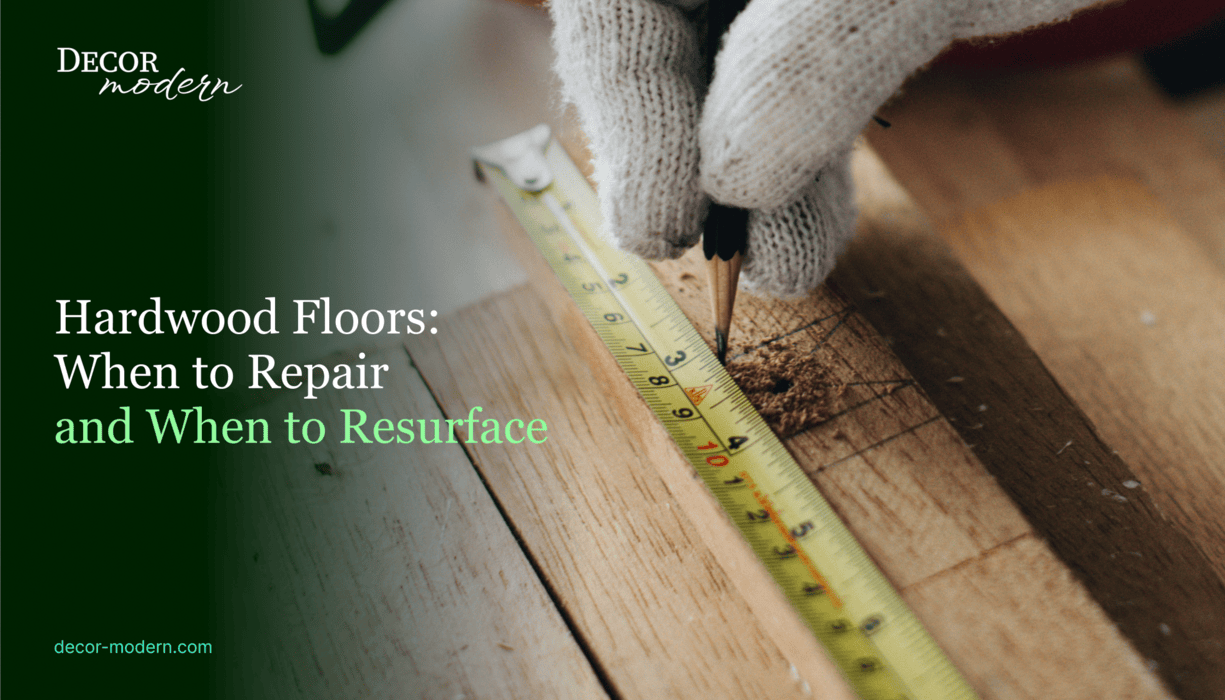
Resurfacing hardwood floor options versus targeted repairs creates a cost dilemma for homeowners dealing with worn or damaged flooring. The numbers tell the story: hardwood floor refinishing costs between $1,099 to $2,660, while repair work averages $1,024. The resurfacing hardwood floors cost depends on your floor’s condition and how much area needs attention. We’ll break down when each option saves you money, what timelines look like, and which choice makes sense for your specific situation.
What Resurfacing Hardwood Floors Actually Means
Most homeowners use “resurfacing” and “refinishing” interchangeably, but the industry distinguishes between these processes based on how much material gets removed. Resurfacing hardwood floors, also called screening and recoating or buff and coat, involves lightly abrading the existing finish without sanding down to bare wood. The process preserves the wood structure while refreshing the protective surface layer.
The Screening and Recoating Process
The procedure uses a specialized mesh screen with abrasive particles attached to a weighted floor buffer machine. This screen works like sandpaper but removes nowhere near as much material because it contains fewer abrasive particles and sits under thick soft pads. The buffer scuffs only the top layer of existing polyurethane finish and creates a rough surface that allows the new coat to bond.
Contractors apply fresh polyurethane or another compatible finish over the abraded surface after screening removes surface imperfections. The whole process generates minimal dust compared to full sanding and completes within 24 hours for water-based finishes or 48 to 72 hours for oil-based products. Floors remain structurally unchanged since no actual wood gets removed during screening.
What Gets Fixed and What Doesn’t
Screening and recoating addresses specific surface-level problems but has clear limitations. The process handles:
- Light scratches and scuff marks that only penetrate the finish layer
- Dull or faded appearance from normal wear and foot traffic
- Minor water rings that haven’t seeped into the wood
- Loss of protective coating in high-traffic areas
But resurfacing hardwood floors cannot remove deep gouges, eliminate heavy discoloration from UV exposure, cover grayish tones in worn areas where wood is already affected, or repair water damage that has penetrated the wood itself. Deep scratches remain visible after recoating because the process doesn’t remove enough material to level them out.
Best Candidate Floors for Resurfacing
Floors in good structural condition with only cosmetic finish damage make ideal candidates. Screening works best when the wood shows no signs of actual damage and wear remains limited to the polyurethane layer. Homeowners often notice their floors losing shine or developing light surface scratches before the wood underneath sustains any real harm.
The process suits floors where entryways and hallways show a bit more wear than other areas but the overall structure remains sound. Floors previously refinished within the past five years also qualify, though the service doesn’t work on pre-finished or engineered floors.
Average Lifespan After Resurfacing
Expect to recoat floors every 3 to 5 years depending on household traffic levels. This regular maintenance schedule delays the need for invasive full refinishing, which occurs every 8 to 12 years. The protective coating loses effectiveness over time and requires renewal even when the finish appears adequate. Regular screening extends overall floor lifespan by preventing deeper wear that would require sanding down to bare wood.
What Hardwood Floor Repair Involves

Image Source: Easiklip Floors
Repair work targets specific damaged areas rather than treating the whole floor surface. This approach makes sense when problems appear isolated to certain planks or sections. Understanding the repair categories helps determine whether fixing individual issues costs less than resurfacing hardwood floors.
Surface-Level Repairs: Scratches and Scuffs
Superficial scratches affect only the finish layer without penetrating into the wood stain or bare wood beneath. These light marks respond well to stain markers or blending pencils matched to your floor color. You apply the marker right to the scratch and then wipe with a clean cloth to blend it naturally.
Minor scratches that go through the finish and touch the wood need wood putty or filler. You clean the area well, apply matching putty, let it dry, then sand with fine-grit sandpaper. Deep gouges that expose bare wood need heated wax sticks to fill the damage. Level with a plastic scraper and buff.
Plank Replacement for Damaged Sections
Damaged boards need careful removal without disturbing neighboring planks. You set a circular saw to the board’s thickness and cut along the seams, staying half an inch inside the plank’s edge. Additional cuts across the board’s center form an ‘H’ pattern. An oscillating multi-tool ensures cuts reach the subfloor.
You wedge a flathead screwdriver into the center cut and tap it down with a rubber mallet. This creates enough gap to fit a crowbar. Once you remove plank pieces, scrape up dried glue and clean the exposed subfloor well. The replacement board needs precise measurement and trimming of the tongue or bottom groove so it fits snugly into place. You apply wood glue to edges, tap the board gently into position and wipe excess glue right away.
Fixing Water Stains and Discoloration
Light water stains affect only the top coating and respond to mineral spirits or small amounts of toothpaste buffed gently with a soft cloth. Dark water stains penetrate deeper into the wood grain and require more aggressive treatment.
You saturate a clean cloth with three percent hydrogen peroxide and dab the stain well. The area needs to air dry overnight. Repeat the process if needed by leaving the peroxide-soaked cloth on the stain for 20 minutes. This method works well but requires caution since hydrogen peroxide acts as a mild bleaching agent.
Structural Repairs: Cupping and Gaps
Cupping occurs when board edges rise higher than the center and creates a concave surface. Fix the moisture source first, whether from leaky pipes or high humidity. The wood needs to dry over days or weeks. Minor cupping may self-correct once moisture levels stabilize.
Wood filler works for gaps less than nickel width. Larger gaps require wood strips cut from matching flooring material. Time repairs for late summer when wood reaches maximum expansion to prevent future buckling.
Resurfacing Hardwood Floors Cost vs Repair Costs in 2026

Image Source: Fabulous Floors
Pricing differences between resurfacing hardwood floors and repair work depend more on square footage and damage extent than homeowners expect at first. The numbers change based on whether you need a simple surface refresh or targeted fixes in specific areas.
National Average for Resurfacing Per Square Foot
Screening and recoating costs between $1.00 and $3.00 per square foot. This lighter process suits floors with only surface wear. Full sand and refinish runs $3.00 to $6.00 per square foot, while adding stain bumps costs to $4.00 to $8.00 per square foot. An 800 square foot area at mid-range pricing totals around $3,600, while 1,000 square feet reaches $4,000. Premium finishes and dust-controlled systems push pricing into the $5.00 to $8.00+ range.
Common Repair Costs by Damage Type
Repair costs vary based on damage severity. Light scratch repair through buff and recoat costs $1.00 to $3.00 per square foot. Deeper scratches that require filling and spot refinishing run $2.00 to $6.00 per square foot. Board replacement for small patches ranges from $5.00 to $20.00 per square foot. Water damage presents the widest cost spread at $8.00 to $100.00 per square foot depending on whether moisture reached the subfloor. Cupping repairs average $2.00 to $6.00 per square foot, while subfloor repair costs $35.00 to $80.00 per square foot.
Labor Costs: DIY vs Professional
Professional labor accounts for 80% of refinishing projects and ranges from $2.00 to $8.00 per square foot or $60.00 to $160.00 per hour. DIY projects require equipment rental: drum sanders cost $60.00 to $100.00 per day and edgers $40.00 to $60.00 per day. A three-day project accumulates $200.00 to $400.00 in rental costs alone. Material costs add another $400.00 to $900.00. Contractors charge $50.00 to $100.00 per hour for repair work.
Hidden Costs and Additional Fees
Furniture moving adds $28.00 to $70.00 per room if you hire professionals. Subfloor repairs become work to be done when foundation issues exist and cost $460.00 to $3,344.00. Dust-controlled sanding systems increase per-square-foot costs but reduce cleanup expenses. Board replacement for pet urine damage adds several hundred dollars since sanding alone won’t remove deep stains. A 10-15% contingency for unexpected repairs makes sense in older homes.
When Resurfacing Saves You More Money
Choosing hardwood floor refinishing over targeted repairs makes financial sense when damage spreads uniformly across your flooring rather than concentrating in isolated spots. Refinishing saves 50% to 75% compared to replacement, making it the smarter choice for widespread surface issues.
Light Wear Across Entire Floor
Foot traffic creates consistent wear throughout your home, and refinishing delivers better value than patching individual areas. Floors showing uniform dullness or light scratching across multiple rooms cost less to refinish once than to repair different sections repeatedly. Refinishing runs $3.00 to $8.00 per square foot while replacement costs $5.00 to $15.00+ per square foot. The math favors resurfacing hardwood floors when wear patterns affect more than 40% of your floor space.
Dull Finish with Minor Surface Scratches
Floors with damage limited to the finish layer respond well to refinishing without requiring extensive prep work. Surface scratches that catch light but don’t penetrate into the wood stain make ideal candidates for screening and recoating. Homeowners face this situation often in living rooms and hallways where daily activity wears down the protective coating over time without damaging the wood underneath.
Sun Fading Without Deep Damage
UV exposure creates discoloration in the finish layer when damage hasn’t penetrated deep into the wood. Refinishing restores even color across sun-faded areas more economically than replacing affected planks. Homes with large windows or glass doors see fading affect broad sections that would cost much more to address through selective board replacement.
Preventive Maintenance Before Major Issues
Refinishing adds 5 to 10 years to floor lifespan and postpones replacement expenses. Solid hardwood floors tolerate 5 to 7 complete refinishing cycles, while floors maintained well last 20 to 30 years without major work. Addressing wear early prevents deeper damage that ends up requiring structural repairs costing $459.00 to $3,344.00.
When Repair Is the More Cost-Effective Choice

Image Source: Wooden Flooring Experts
Targeted repairs beat whole-floor refinishing when problems concentrate in specific zones rather than spreading uniformly. Repair makes more financial sense once damage stays localized to less than 30% of total floor area.
Isolated Damage in Specific Areas
Repair costs less for small sections, but once repairs exceed 50% to 70% of refinishing costs, refinishing delivers better value. Repairing 10 to 50 square feet makes sense, but larger areas make full-room refinishing more sensible both visually and financially.
Deep Scratches or Gouges in Few Planks
Gouges expose bare wood and remove material that buffing cannot restore. Board replacement costs $5.00 to $20.00 per square foot, which keeps costs down for a few damaged planks. Refinishing the entire floor to address three gouged boards wastes money on undamaged areas.
Water Damage Limited to One Section
Minor water damage repair runs $800.00 to $2,000.00, while moderate damage with board replacement costs $2,000.00 to $4,000.00. Repair makes sense when moisture affects one area. Widespread water damage costing $5,000.00+ often justifies replacement instead.
Pet Stains or Urine Damage
Ammonia in pet urine penetrates wood and burns it black. Sanding won’t remove these stains since they go deep into the wood grain. Board replacement is your only option, costing less than refinishing an entire room for scattered urine spots.
When Your Floor Has Been Resurfaced Multiple Times
Solid hardwood tolerates 4 to 7 refinishes before the boards get too thin. Boards that are too thin lose stability. Replace sections that show wear instead of trying another refinish that compromises structural integrity.
Comparison Table
Resurfacing vs Repair: Complete Cost Comparison Table
| Attribute | Resurfacing (Screening & Recoating) | Targeted Repair |
| Average Total Cost | $1,099 to $2,660 | $1,024 average |
| Cost Per Square Foot | $1.00 to $3.00 (screening) $3.00 to $6.00 (full refinish) $4.00 to $8.00 (with stain) | Light scratches: $1.00 to $3.00 Deep scratches: $2.00 to $6.00 Board replacement: $5.00 to $20.00 Water damage: $8.00 to $100.00 Cupping: $2.00 to $6.00 |
| What It Fixes | • Light scratches and scuff marks • Dull or faded appearance • Minor water rings (surface only) • Loss of protective coating • Uniform wear across the whole floor | • Deep gouges and scratches • Isolated damaged planks • Pet urine stains • Localized water damage • Structural issues (cupping, gaps) |
| What It Cannot Fix | • Deep gouges • Heavy UV discoloration in wood • Water damage penetrated into wood • Pet urine stains • Structural damage | N/A (can address most issues through board replacement) |
| Best Candidate Floors | • Floors with surface-level damage only • Uniform wear across 40%+ of floor • Refinished within the last 5 years • Wood that’s sound structurally | • Damage limited to under 30% of floor • Isolated problem areas • Floors refinished multiple times (4-7 times max) • Deep damage in few planks |
| Time to Complete | 24 hours (water-based finish) 48-72 hours (oil-based finish) | Varies by repair type: • Scratch repair: 30-90 minutes • Board replacement: Several hours • Water damage: Days to weeks (drying time) |
| Lifespan/Frequency | Every 3 to 5 years (screening) Every 8 to 12 years (full refinish) Adds 5 to 10 years to floor life | Permanent for replaced boards Surface repairs may need touch-ups |
| DIY Equipment Costs | Drum sander: $60 to $100/day Edger: $40 to $60/day Buffer: $40 to $60/day Total 3-day rental: $200 to $400 Materials: $400 to $900 | Minimal tools needed: • Stain markers: $5 to $15 • Wood putty: $10 to $20 • Wax sticks: $15 to $30 • Hand tools (simple) |
| Professional Labor Costs | $2.00 to $8.00 per sq ft $60 to $160 per hour (80% of total project cost) | $50 to $100 per hour Minor water damage: $800 to $2,000 Moderate damage: $2,000 to $4,000 |
| Most Cost-Effective When | • Light wear across the whole floor • Dull finish with minor scratches • Sun fading without deep damage • Preventive maintenance • Damage affects 40%+ of floor | • Isolated damage in specific areas • Deep scratches in few planks • Water damage in one section • Pet stains (localized) • Damage affects under 30% of floor |
| Hidden/Additional Costs | Furniture moving: $28 to $70/room Subfloor repairs: $460 to $3,344 Dust-controlled systems: extra cost 10-15% contingency recommended | Subfloor repair: $35 to $80 per sq ft Matching wood for replacement: varies Finish blending to achieve a seamless look |
| Skill Level Required | Advanced (DIY) Professional recommended | Beginner to Intermediate (surface repairs) Intermediate to Advanced (board replacement) |
| Material Removed | Minimal (only finish layer abraded) | Varies: • Surface repairs: none • Board replacement: damaged plank removed entirely |
| Comparison to Replacement | Saves 50% to 75% vs replacement | Minor repairs: $800 to $2,000 Widespread damage $5,000+: replacement may be better |
Quick Decision Guide
Choose Resurfacing When:
- Damage is uniform over more than 40% of your floor
- Only the finish layer is affected (no wood damage)
- You want preventive maintenance to extend floor life
- Your floor hasn’t been refinished more than 4-7 times
Choose Repair When:
- Damage is isolated to under 30% of floor area
- You have deep gouges or pet stains in specific spots
- Water damage is limited to one section
- Repair costs stay below 50-70% of refinishing costs
Conclusion
The resurfacing hardwood floor versus repair decision depends on damage distribution rather than total cost alone. Resurfacing saves you more when wear spreads across 40% or more of your floor area. You’ll spend $1,099 to $2,660 for complete coverage. Repair works better when problems stay isolated to specific planks or sections under 30% of your total space.
Your floor’s condition tells you which path saves money:
- Choose resurfacing for uniform surface wear, dullness, or light scratching throughout multiple rooms
- Choose repair for deep gouges, pet stains, or water damage confined to particular areas
- Calculate the breakpoint: repair costs exceeding 50-70% of refinishing expenses justify whole-floor treatment
Your floor’s refinishing history also matters, since solid hardwood tolerates only 4 to 7 complete refinishes before boards become structurally compromised.
FAQs
Q1. How much does it typically cost to refinish 1,000 square feet of hardwood floors in 2026? For 1,000 square feet, you can expect to pay around $4,000 for standard refinishing. The cost per square foot ranges from $3.00 to $6.00 for basic sand and refinish, or $4.00 to $8.00 if you’re adding stain. Screening and recoating, which is a lighter process, costs between $1.00 and $3.00 per square foot. Your final price depends on your location, the condition of your floors, and whether you need additional services like furniture moving or subfloor repairs.
Q2. Can I save money by refinishing hardwood floors myself instead of hiring a professional? DIY refinishing can save on labor costs, but requires significant equipment rental expenses. You’ll spend $200 to $400 for a typical three-day rental of sanders and buffers, plus $400 to $900 in materials. Professional labor accounts for about 80% of refinishing costs at $2.00 to $8.00 per square foot. While DIY is possible, it’s physically demanding and requires skill to avoid costly mistakes. Many homeowners find that improper DIY work ends up costing more when they need to hire professionals to fix errors.
Q3. When should I choose to repair specific areas instead of refinishing the entire floor? Repair makes more financial sense when damage is isolated to less than 30% of your floor area. This includes situations like deep scratches in just a few planks, water damage limited to one section, or pet stains in specific spots. Once repair costs exceed 50-70% of what refinishing would cost, it’s better to refinish the entire floor for both visual consistency and value.
Q4. How often do hardwood floors need to be resurfaced or refinished? Screening and recoating should be done every 3 to 5 years to maintain the protective finish, while full refinishing is typically needed every 8 to 12 years depending on traffic levels. Regular resurfacing extends your floor’s overall lifespan by preventing deeper wear. Keep in mind that solid hardwood can only be fully refinished 4 to 7 times before the boards become too thin and structurally compromised.
Q5. What types of damage can resurfacing fix versus what requires repair? Resurfacing effectively addresses light scratches, scuff marks, dull finishes, and minor water rings that only affect the surface coating. However, it cannot fix deep gouges that expose bare wood, pet urine stains that penetrate into the wood, heavy water damage, or structural issues like cupping and gaps. These deeper problems require targeted repairs such as board replacement or specialized treatments.