
In this guide
Scrolling through inspiration photos is easy. Turning those photos into a room that actually works in your house is a different problem entirely—especially if you’re not sure which style you’re even drawn to, or what it costs to pull off.
Here’s a breakdown of the major interior design styles and what each one actually costs.
Pick a Style First
Most people shop first and figure out their style later. Start with your home’s bones instead: a Victorian with detailed molding needs a different approach than a boxy modern apartment. Fight the architecture and you end up with a room where nothing quite fits.
Keep in mind your routine—a house with kids needs washable fabrics and furniture that can take a hit. A house with cats needs scratch-resistant materials.
The Major Styles
Modern
Clean lines, minimal ornamentation, monochromatic palettes. Materials stay close to their natural state: unpainted wood, metal, leather, concrete. Form follows function, and floor-to-ceiling windows and open floor plans are signature moves.
Contemporary
Means “of the moment,” which is why it keeps shifting. Where modern is locked to a historical era, contemporary tracks whatever’s current. Expect clean lines mixed with curves, neutral palettes punctuated by bold accents, and sculptural lighting. It borrows freely from minimalism and Scandinavian design.
Traditional
Rooted in 18th and 19th century European decor. Rich wood tones—mahogany, cherry, maple—carved details, button-tufted upholstery, symmetrical room layouts. Furniture and accessories tend to appear in pairs. Color palettes lean on neutral walls with deep reds, greens, and jewel tones for accent.
Transitional
A blend of traditional warmth and modern restraint. Neutral palettes—white, cream, tan, gray—with the occasional pop of color. Straight lines and curves coexist in the same room (a linear sofa paired with a round ottoman is a classic move). It’s the style for people who don’t want to commit fully to one camp.
Scandinavian
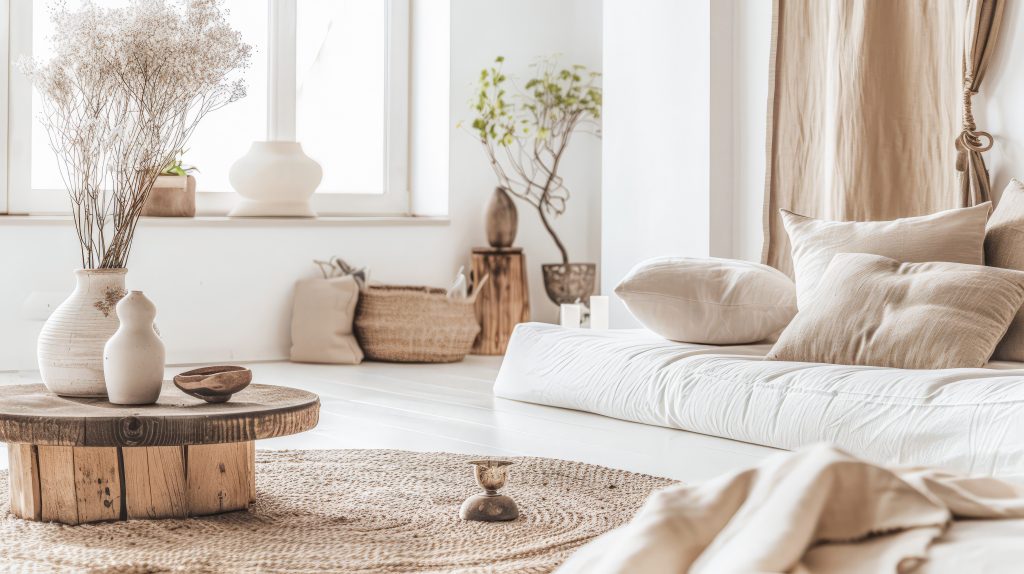
Built around minimalism, function, and natural materials. Light, neutral palettes, wood textures, cozy textiles—the concept of hygge runs through all of it. Large uncovered windows make the most of limited daylight. Nothing decorative gets added without a reason.
Minimalist
This one is about owning only what serves a purpose. It contains clean lines, limited ornamentation, and neutral colors. Natural materials add warmth so the space doesn’t look like a hospital.
Coastal
Soft, beach-inspired tones—blues, whites, creams, sage greens, grays. Natural textures: linen, jute, rattan, light wood. Large windows, slipcovered furniture, and an emphasis on feeling relaxed rather than formal.
Finding Your Style
- Get inspired—check Pinterest boards or even hotel lobbies for color and shape ideas.
- Work with what you already have—your existing tastes are more reliable than copying someone else’s ones.
- Build a mood board—physical boards with fabric and paint samples are better than a digital collage.
- Test before committing—paint a small swatch before investing in gallons of expensive paint.
Mistakes to Avoid
- Chasing trends. Interior designer Christopher Stevens has pointed out that what looks current today often reads as dated within five years. The fix isn’t avoiding trends entirely—it’s keeping them out of the expensive, permanent stuff.
- Mixing too many styles. It works when one dominates and the others support. Otherwise a room starts to feel like different decorating decisions stacked on top of each other.
- Underestimating cost. The unglamorous parts of a renovation—plumbing, insulation, drainage—are the ones people forget to budget for. A 20% cushion on top of your estimated total covers most of what gets missed.
What Styles Actually Cost
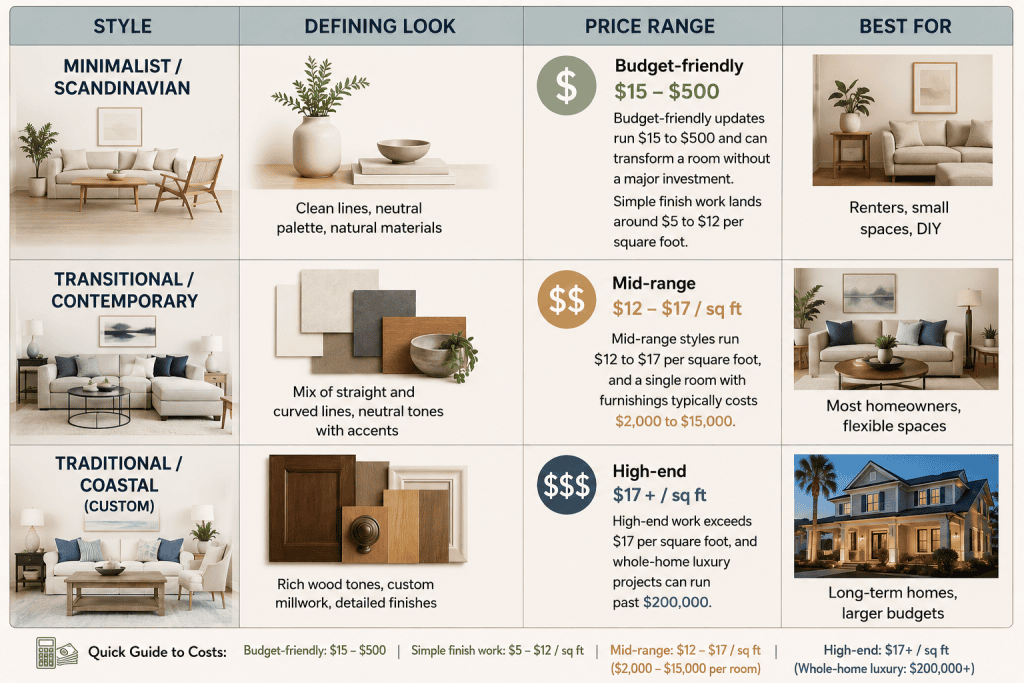
Prices were sourced from various references (ShowPlaceHQ, Brown Interiors) and may vary depending on a number of factors.
When It’s Time to Call a Designer
- You just can’t pick one style. A designer’s job is narrowing the long list of various design options to a handful that actually fits your space and budget.
- When structural changes are needed—moving walls, custom millwork, full kitchen remodels.
Design services run $2,000 to $15,000 per project, with hourly rates between $100 and $500. Online design services are a lower-cost option.
Bottom Line
Start with your home’s architecture and how you actually live in it—not whatever’s trending. You can build a mood board and test it on a few small purchases first. Then go big once you know it works. Choose something you will still enjoy seeing in 5 years. This will save you lots of money.
Sources
Every external claim in this guide links to its origin. Collected automatically from the text above.
- has pointed out — architecturaldigest.com
- ShowPlaceHQ — showplacehq.com
- Brown Interiors — browninteriors.com

Nina Kowalski
Nina covers flooring, renovation planning, and DIY repair guides for Decor Modern. Her focus is translating contractor-level knowledge into step-by-step instructions that a homeowner can actually follow on a Saturday morning. Before writing about home improvement, Nina spent four years managing renovation projects for residential properties in the Midwest — coordinating work between flooring installers, painters, and general contractors. She worked on projects ranging from single-room updates to full-home renovations, gaining firsthand experience in budgeting, timelines, and contractor coordination. That experience taught her which shortcuts work, which ones backfire, and how much things really cost when the estimate meets reality. She saw how initial estimates change once work begins — and which decisions tend to increase costs or cause delays. Her most-read articles on Decor Modern include a guide to fixing scratches on hardwood floors and a breakdown of the cost to refinish hardwood floors. She also writes the site's cost comparison pieces, where she digs into real pricing data rather than repeating vague national averages. Her writing is grounded in real project constraints — including labor availability, material costs, and unexpected issues that arise during renovation. Nina holds a degree in Communications and has contributed home improvement content to several online publications. She lives in Ohio, where she is currently refinishing the original oak floors in a 1948 Cape Cod — one room at a time.