Choosing the best flooring for kitchen spaces often trips up homeowners because kitchens just need more from flooring than any other room. Spills and heavy foot traffic combined with moisture exposure mean your kitchen flooring material options must balance durability with style. Water resistance determines how long your floor lasts. We tested 11 types of kitchen floors to identify the best waterproof flooring for kitchen use and compared porcelain tile, luxury vinyl, hardwood and more. This piece breaks down kitchen flooring options with real-life costs, installation requirements and practical trade-offs.
Porcelain Tile Flooring
What Makes Porcelain Tile Stand Out
Porcelain achieves superior performance through a manufacturing process that compresses refined clay at high density and then fires it at extreme temperatures. This creates a tile with flexural strength exceeding 35 MPa and a water absorption rate below 0.5%. Porcelain’s dense composition makes it nearly impervious to moisture penetration, unlike ceramic tiles made from coarser clay. Homeowners looking for the best waterproof flooring for kitchen use find porcelain stands up to dishwasher leaks, sink overflows and daily spills without damage. Liquids cannot penetrate the surface, so the material resists staining from coffee, wine and cooking oils.
Porcelain Tile Pros and Cons
Durability defines porcelain’s main advantage. These tiles last 15 to 50 years depending on quality and resist scratches from pet claws, chair legs and dropped utensils. The non-porous surface prevents bacteria, mold and mildew growth, which makes porcelain hygienic for food preparation areas. Hot pans won’t leave marks because of heat resistance, and direct sunlight won’t cause fading. Design options range from wood-look planks to marble-inspired patterns. Homeowners can achieve high-end esthetics without natural stone maintenance requirements.
But porcelain feels cold underfoot during winter months. The hard surface can strain feet and joints during extended cooking sessions. Weight poses installation challenges on upper floors where structural support must be verified. Glossy finishes become slippery when wet and create safety risks. Edge chipping can occur in high-traffic areas or when heavy objects drop, though through-body porcelain helps disguise such damage.
Best For These Kitchens
Porcelain works best in high-traffic kitchens where moisture exposure is frequent. Homes with active families, pets or heavy daily use benefit from porcelain’s scratch and stain resistance. The material suits kitchens that just need a floor rated PEI 5 for commercial-grade durability. Homeowners planning to install radiant heating find porcelain transfers heat efficiently despite its natural coldness.
Porcelain Tile Cost Range
Material costs range from $3 to $10 per square foot for standard porcelain, with premium designs reaching $15 per square foot. Professional installation adds $4 to $15 per square foot and brings total installed costs to $15 to $50 per square foot. Big-box retailers often offer lower prices on in-stock patterns.
Installation and Maintenance
Professional installation is necessary because of porcelain’s weight and cutting requirements. The dense material demands specialized saws for precise cuts. Improper handling leads to expensive waste. Homeowners should verify subfloor strength before installation on upper levels.
Daily maintenance just needs sweeping and damp mopping with pH-neutral cleaners. Porcelain itself never needs sealing, but grout lines must be sealed 72 hours after installation and resealed periodically to prevent staining. Avoid acidic or ammonia-based cleaners that damage grout. Wipe spills promptly to prevent grout discoloration.
Luxury Vinyl Plank (LVP) Flooring

Image Source: CALI Floors
What Makes LVP Stand Out
Luxury vinyl plank emerged as the most popular kitchen flooring choice in 2026 because it combines waterproof performance with realistic wood visuals and DIY-friendly installation. Long-term durability depends on the wear layer: entry-level products use 6-8 mil thickness, mid-range options feature 12-16 mil, and premium planks offer 20+ mil protection. This transparent top coating resists scratching and denting, especially when you have children or pets. Core construction affects both performance and price. Stone Polymer Composite (SPC) creates a dense, dent-resistant floor using limestone powder and stabilizers. This makes it ideal for high-traffic kitchens. Wood Polymer Composite (WPC) uses thicker material ranging from 7-8mm that feels softer underfoot and reduces leg fatigue during extended cooking sessions.
LVP Pros and Cons
LVP’s waterproof rigid core prevents swelling from sink splashes or dishwasher leaks. The resilient surface absorbs impact better than tile when you drop objects on the floor, though heavy items can still cause dents. Grease, sauce and wine spills wipe clean without staining. The absence of grout lines eliminates discoloration concerns. Advanced printing technology replicates authentic wood grain variations and knot patterns. Click-lock systems require no specialized tools to install.
But heavy furniture like gym equipment or pool tables can distort and warp the material. Sharp knives may leave dents or punctures. Direct sunlight causes fading over time and requires UV-blocking window film or furniture rearrangement from time to time. The surface resists water, but moisture from below can affect foam or cork backing and develop mold if concrete slabs or basements lack proper vapor barriers.
Best For These Kitchens
LVP suits active households with pets and frequent spills. Homeowners who install floors themselves benefit from click-lock systems that eliminate adhesive requirements. Kitchens requiring comfortable standing surfaces find WPC-core products reduce fatigue compared to tile or hardwood.
LVP Cost Range
Material costs span USD 2.00-8.00 per square foot. Budget options (USD 2.00-3.50) feature 6-12 mil wear layers, mid-range products (USD 3.50-5.50) include 12-20 mil protection, and premium planks (USD 5.50-8.00) offer 20-28 mil wear layers with registered embossing. Professional installation adds USD 1.50-4.00 per square foot and brings total installed costs to USD 3.50-12.00 per square foot.
Installation and Maintenance
Run LVP under dishwashers at all times, as leaks onto bare subfloor create hidden water damage. Use plywood shims under refrigerators to prevent denting. Kitchen islands require careful measurement to maintain expansion gaps around the perimeter. Sweep daily and damp mop with pH-neutral cleaners or one cup vinegar per gallon of water. Ammonia-based products, wax and steam mops on high settings should be avoided.
Ceramic Tile Flooring
What Makes Ceramic Tile Stand Out
Ceramic tiles deliver classic kitchen esthetics at budget-friendly prices through a manufacturing process using natural clay particles fired at lower temperatures than porcelain. This creates a slightly more porous material with approximately 3-10% water absorption compared to porcelain’s sub-0.5% rate. Homeowners seeking kitchen flooring options on tighter budgets find ceramic offers glazed surfaces that resist stains and moisture while costing substantially less than porcelain or natural stone. Modern printing technology replicates marble, travertine, and wood grain patterns, giving kitchens high-end looks without premium pricing. Wide-format tiles make smaller kitchens appear larger, while mosaic patterns add visual interest.
Ceramic Tile Pros and Cons
Ceramic handles muddy footprints and spills with minimal maintenance. Dry dusting with a broom or vacuum followed by damp mopping with hot water and mild cleaning solution keeps floors clean. The hard surface doesn’t attract or hold dirt, dust, or allergens, making ceramic a hygienic choice for food preparation areas. Residential kitchens need rigidity rating four, while commercial spaces require rating five. Both are achievable with ceramic tiles. The massive variety of colors and shapes including triangles and planks, plus affordable pricing, make ceramic available for most budgets.
Ceramic cracks more easily than porcelain as floors settle, and dropped dishes shatter on impact almost every time. The surface feels cold and hard underfoot, especially during winter months when ceramic doesn’t retain heat well. This makes standing for prolonged cooking sessions uncomfortable without rugs or cushioned mats in high-traffic areas. Glazed ceramics become slippery when wet, creating hazards where water spills occur often. Grout lines require sealing every few years and specialty cleaning to prevent staining between tiles.
Best For These Kitchens
Ceramic works best for residential kitchens with moderate traffic and homeowners prioritizing style variety over maximum durability. Budget-conscious renovations benefit from ceramic’s lower material costs while achieving attractive results.
Ceramic Tile Cost Range
Materials range from $3.00-6.00 per square foot for simple ceramic to $8.00-15.00 per square foot for designer or large-format options. Professional installation adds $3.00-15.00 per square foot. Total installed costs reach $12.00-45.00 per square foot. Intricate patterns increase installation costs 10-20%.
Installation and Maintenance
Professional installation prevents cracking from improper underlayment or uneven subfloors. Sweep regularly and mop with neutral pH cleaners. Seal grout every 2-5 years at $50-100 for DIY or $150-300 with professional help.
Engineered Hardwood Flooring
What Makes Engineered Hardwood Stand Out
Engineered hardwood features a genuine hardwood veneer bonded to a cross-ply core, where multiple plywood or high-density fiberboard layers run in opposing grain directions. This construction counteracts wood movement and makes engineered products substantially more dimensionally stable than solid hardwood in moisture-variable environments. The National Wood Flooring Association recommends engineered hardwood for kitchens and lower-level spaces where solid wood performs poorly. Top layer thickness determines refinishing potential. Wear layers of 3mm or thicker allow sanding and refinishing, while thinner veneers under 3mm limit restoration options. Factory-applied aluminum oxide finishes deliver substantial scratch resistance and outperform site-applied coatings. Species options match solid hardwood availability, including white oak, hickory, and maple, with no repeating image patterns found in laminate or vinyl.
Engineered Hardwood Pros and Cons
Advantages: Real wood esthetics add measurable resale value according to the National Association of Realtors. The cross-ply core resists warping from dishwasher steam or sink splashes better than solid planks. Installation flexibility has floating, glue-down, and nail-down methods over wood subfloors, concrete, or radiant heating systems. Wide planks measuring 7-10 inches create contemporary looks. Quality products last 25-30 years. Premium options reach 50-80 years when managed to keep them properly. Manufacturers like Hartco offer waterproof versions with specialized cores that provide 100% water protection.
Drawbacks: Standing water still damages standard engineered hardwood despite improved moisture tolerance. Refinishing cycles max out at 1-4 times depending on veneer thickness, nowhere near solid hardwood’s 5-10 refinishes. Scratches and dents occur from dropped utensils, pet claws, and chair dragging. Thin veneers under 2mm create disposable floors at premium prices.
Best For These Kitchens
Engineered hardwood suits homeowners who prioritize authentic wood appearance with better moisture performance than solid options. Kitchens with humidity fluctuations near dishwashers or variable climate conditions benefit from the stable core construction.
Engineered Hardwood Cost Range
Materials range USD 5.00-11.00 per square foot. High-end products reach USD 13.00 for thick veneers and exotic species. Installation adds USD 3.00-8.00 per square foot and brings total installed costs to USD 9.00-20.00 per square foot.
Installation and Maintenance
Acclimation requires storing planks in the installation room for 5-7 days before installation. Sweep or vacuum with brush attachments and avoid beater bars. Damp mop with wood-safe cleaners only. Never use wet mops, steam cleaners, or ammonia-based products. Wipe spills right away to prevent water penetration between boards.
Laminate Flooring

Image Source: home.tarkett.com
What Makes Laminate Stand Out
Budget constraints push many homeowners toward laminate, which delivers wood or stone esthetics at USD 1.00-5.00 per square foot for materials, roughly one-third the cost of engineered hardwood. Multi-layered construction creates durability through a wear layer that protects against scratches, a decorative layer that provides visual appearance, a core layer using high-density fiberboard for stability, and a backing layer that adds moisture resistance. AC ratings indicate durability levels: AC1-AC2 suits low-traffic areas, AC3 handles standard residential use, while AC4-AC5 withstands high-traffic or light commercial spaces. The top wear layer determines longevity. Kitchens need 12 mil thickness, while 20 mil offers superior scratch protection.
Laminate Pros and Cons
Laminate resists scratches and stains better than hardwood due to the melamine resin wear layer bonded under extreme pressure. Design versatility has realistic wood grains that mimic oak, walnut, or maple, plus stone looks that replicate slate or marble without cold surfaces or grout maintenance. Click-lock installation makes laminate the easiest kitchen flooring option for DIY projects and creates floating floors that require no nails, staples, or glue. Daily cleaning needs only sweeping and occasional damp mopping.
Standing water causes irreversible damage when moisture penetrates seams into the wood composite core and leads to buckling and warping. Repairs prove difficult because matching replacement planks becomes challenging as manufacturers release new designs continuously. Laminate cannot be refinished once worn and requires complete replacement after 15-25 years. Environmental concerns exist as the plastic wear layer doesn’t degrade in landfills.
Best For These Kitchens
Laminate works for homeowners who prioritize affordability over maximum water resistance. Families wanting wood esthetics without hardwood maintenance find laminate practical, provided spills get wiped immediately.
Laminate Cost Range
Materials cost USD 1.00-2.00 per square foot for basic options, USD 2.00-3.50 for mid-range, and USD 3.50-5.00 for premium waterproof versions. Labor adds USD 2.00-8.00 per square foot and brings total installed costs to USD 3.00-13.00 per square foot.
Installation and Maintenance
Acclimate planks 48-72 hours before installation. Leave 1/4-inch expansion gaps around perimeters to prevent buckling. Use microfiber mops with laminate-specific cleaners or vinegar-water solutions. Avoid steam mops, wax-based products, and excessive water.
Natural Stone Flooring

Image Source: Natural Stone Consulting
What Makes Natural Stone Stand Out
Granite, marble, slate, limestone, travertine and sandstone each bring distinct patterns formed over millions of years through geological processes. Granite develops speckled appearances from cooled magma, while marble displays veining from limestone subjected to extreme heat and pressure. Slate offers natural layering with rich dark tones, and travertine contains characteristic pitting and warm colors. No two tiles match exactly. This creates one-of-a-kind floors that manufactured products cannot replicate. Natural stone becomes non-porous when sealed properly and prevents bacteria buildup. This makes it hygienic in food preparation areas.
Natural Stone Pros and Cons
Natural stone withstands decades of use. Floors that are managed to keep properly can last 50+ years. The material resists heat from dropped pans and scratches from daily traffic better than most kitchen flooring options. Stone adds measurable resale value as buyers view it as a premium feature. Granite is very durable and resistant to scratches, while slate’s non-porous surface resists stains without requiring sealing. The natural cooling properties help maintain comfortable temperatures during summer months.
But stone requires regular sealing every 1-3 years depending on type and traffic levels. Marble and limestone need sealing every 6-12 months, while granite extends to 12-24 months. Softer stones like marble and limestone scratch more easily and react to acidic substances such as lemon juice or vinegar. This causes permanent etching. The hard surface feels cold and uncomfortable during extended standing and can strain feet and joints. Repairs to fix chipped areas can be expensive and labor-intensive.
Best For These Kitchens
Natural stone suits homeowners who prioritize authentic materials and are willing to invest in premium flooring. High-traffic family kitchens benefit from granite and slate durability. Mediterranean or rustic design schemes pair well with travertine’s earthy tones.
Natural Stone Cost Range
Material costs range USD 5.00-30.00+ per square foot, with marble reaching USD 100.00-250.00 per square foot, slate at USD 50.00-80.00, and granite USD 70.00-175.00. Installation adds USD 5.00-15.00 per square foot. This brings total installed costs to USD 10.00-45.00 per square foot.
Installation and Maintenance
Professional installation is necessary due to substrate preparation requirements and cutting complexity. Installers must verify subfloor deflection ratings meet L/720 standards and ensure 95% mortar coverage for tiles 5/8-inch or thinner. White flexible adhesive prevents irreversible discoloration. Apply penetrating sealers before and after grouting. Clean daily with pH-neutral cleaners and avoid acidic or ammonia-based products. Use mats at entryways to reduce abrasive grit tracked onto floors.
Luxury Vinyl Tile (LVT) Flooring

Image Source: Karndean flooring
What Makes LVT Stand Out
Square and rectangular tile formats distinguish LVT from plank versions. Stone-look designs replicate marble, slate, travertine and concrete through advanced 3D printing technology that adds depth and realism. The manufacturing process fuses multiple layers under high heat and pressure: vinyl backing, rigid core (often Stone Plastic Composite using limestone and stabilizers), printed design layer and protective wear layer. Large-format 12Γ24 tiles minimize grout lines for cleaner appearances, while varied surface textures improve slip resistance. LVT provides 80% of porcelain tile’s visual appeal at 50% of the cost. This makes it attractive for homeowners wanting stone esthetics without the expense.
LVT Pros and Cons
Waterproof construction handles dishwasher leaks and sink overflows without warping. Antibacterial coatings applied during manufacturing discourage microorganism growth. The cushioned underlayer reduces standing fatigue compared to hard stone surfaces, while sound-absorbing properties cut noise transmission between floors by up to 19dB. Stain resistance prevents damage from cooking spills. Maintenance requires only sweeping and damp mopping with pH-neutral cleaners.
But LVT lasts 15-25 years versus porcelain’s 50+ year lifespan. Direct sunlight causes fading over time. Damaged sections need replacement since LVT cannot be refinished like wood. Glue-down installations become harder to remove as adhesive strengthens. Lower-quality products appear artificial.
Best For These Kitchens
High-traffic family kitchens benefit from LVT’s durability and easy cleanup. Moisture-prone areas near sinks and dishwashers suit the waterproof core construction.
LVT Cost Range
Materials range USD 2.00-12.00 per square foot, with installation adding USD 2.00-5.00. Total costs reach USD 4.00-17.00 per square foot.
Installation and Maintenance
Three installation methods include peel-and-stick (least expensive), glue-down (professional recommended) and click-lock systems. Adapt tiles 48-72 hours before installation. Clean with microfiber mops and pH-neutral solutions. Avoid steam mops, wax, vinegar and bleach.
Solid Hardwood Flooring

Image Source: The Tile Shop
What Makes Solid Hardwood Stand Out
Solid hardwood gets milled from a single piece of wood that’s 3/4-inch thick. It stands apart from engineered products because you can sand it down and refinish it 5-10 times over its lifespan. This refinishing capability means scratches, dents, or color changes need restoration rather than replacement. Unfinished planks get installed and then stained on-site. This creates surfaces where boards butt tightly together, with sealer coats covering the whole floor to prevent water penetration. Prefinished options arrive with factory-applied aluminum oxide finishes that resist scratches better than site-applied polyurethane but create visible beveled edges between planks. Species selection affects durability and appearance. Oak, maple, and cherry offer standard domestic options at lower costs, while tropical hardwoods like Brazilian walnut command premium pricing.
Solid Hardwood Pros and Cons
Solid hardwood delivers 60-80 years of lifespan. Proper care extends performance to 100+ years. The material adds measurable resale value and helps homes sell faster as buyers view hardwood as a premium feature. Natural grain patterns create warmth that ties open-concept kitchens to adjacent living spaces. Refinishing costs USD 3.00-5.00 per square foot, nowhere near what complete floor replacement would cost.
But moisture remains solid hardwood’s weakness. Spills left unattended cause warping, cupping, or swelling. Humidity fluctuations trigger expansion and contraction. Professional installation with proper expansion gaps becomes essential. Scratches from pet nails occur more easily than with porcelain or LVT. Dog owners need to trim nails every 1-2 weeks.
Best For These Kitchens
Open-concept homes benefit most from solid hardwood’s visual continuity between rooms. Homeowners willing to wipe spills right away and maintain consistent 35-55% humidity levels find hardwood rewarding.
Solid Hardwood Cost Range
Materials range USD 5.00-10.00 per square foot for domestic species, with tropical hardwoods starting at USD 8.00. Installation adds USD 4.00-9.00 per square foot. Total installed costs come to USD 11.00-25.00 per square foot.
Installation and Maintenance
Professional nail-down installation requires wood subfloors and 5-7 day acclimation periods. Sweep with soft-bristle attachments and damp mop with wood-safe cleaners only. Never use wet mops, steam cleaners, or vinegar. Wipe spills right away and maintain indoor humidity between 35-55%.
Cork Flooring
What Makes Cork Stand Out
Cork oak tree bark yields this material without cutting the tree down, making it one of the most sustainable kitchen flooring options you can find. The cellular structure contains millions of tiny air pockets that create natural cushioning and make standing during meal preparation substantially more comfortable than tile or hardwood. These same air cells provide thermal insulation that keeps floors warmer in winter and quieter throughout the day by absorbing sound from dropped utensils and footsteps. Cork contains suberin, a waxy substance that repels water, mold and mildew while offering antimicrobial protection around food preparation areas.
Cork Pros and Cons
The springy surface of cork reduces foot and joint fatigue during extended cooking sessions. The material resists insects and provides slip resistance when sealed. Cork regenerates after harvesting, which appeals to environmentally conscious homeowners.
But cork requires resealing every 12-18 months to maintain water resistance. Heavy furniture creates permanent indentations without furniture pads underneath. Pet claws scratch the softer surface more than vinyl or tile. Direct sunlight causes fading and discoloration over time. Standing water that isn’t wiped right away can penetrate seams and damage the material.
Best For These Kitchens
Cork suits family kitchens where comfort matters more than maximum durability. Eco-conscious homeowners who prioritize sustainable materials benefit from the renewable harvesting process of cork.
Cork Cost Range
Materials cost USD 3.00-9.00 per square foot. Professional installation adds USD 2.00-4.00 for floating floors or USD 4.00-8.00 for glue-down applications and brings total installed costs to USD 5.00-17.00 per square foot.
Installation and Maintenance
Floating cork floors in kitchens require two coats of water-based polyurethane on seams to protect the HDF core from water damage. Acclimate planks 48-72 hours before installation. Clean with pH-neutral solutions only and avoid ammonia, bleach, Simple Green, Murphy’s Oil Soap or steam mops. Place felt pads under moveable furniture and coasters beneath permanent pieces. Reseal every 12-18 months using products like Loba 2K Supra AT polyurethane.
Bamboo Flooring

Image Source: BuildDirect
What Makes Bamboo Stand Out
Bamboo is technically a grass rather than wood. It reaches maturity in just 5 years versus 40-80 years for traditional hardwoods. This makes it one of the most eco-friendly kitchen flooring options. Strand woven bamboo compresses raw bamboo strands under intense heat and pressure. The result is flooring 2-3 times harder than oak and maple. This manufacturing process produces material with distinctive marbled grain patterns that add visual warmth to kitchen spaces. Water-resistant versions handle splashes and minor spills well, though the material isn’t completely waterproof. Bamboo costs $3.00-8.00 per square foot delivered, roughly half the price of comparable hardwoods while matching or exceeding their durability.
Bamboo Pros and Cons
Strand woven bamboo resists scratches from pet claws and dropped utensils better than most wood options. You can refinish the material at least twice. This extends its lifespan beyond many engineered products. Bamboo regenerates without replanting since roots remain in the ground after harvesting. VOC emissions measure so minimally they’re nearly undetectable.
Vertical and horizontal bamboo types suffer from weak internal structure and scratch easily. Standing water left for 20+ hours causes damage and requires immediate spill cleanup. Direct sunlight removes color, and humidity fluctuations may cause warping. Quality varies substantially between manufacturers, especially when you have imports that may contain urea-formaldehyde adhesives.
Best For These Kitchens
High-traffic family kitchens with pets benefit from strand woven bamboo’s superior hardness. Eco-conscious homeowners who prioritize renewable materials find bamboo lines up with sustainability goals while delivering hardwood esthetics.
Bamboo Cost Range
Materials range $1.00-5.00 per square foot for horizontal and vertical types, while strand-woven options cost $3.00-6.00. Professional installation adds $2.50-6.00 per square foot. Total installed costs come to $7.00-16.00 per square foot.
Installation and Maintenance
Planks need to adjust a minimum 48 hours in installation rooms. Four installation methods include floating with tongue-and-groove, floating with click-lock, secret nailing to wood subfloors, or gluing to concrete or wood. Strand woven bamboo requires 18-gage pneumatic nailers with 90-120 PSI settings. Sweep with soft-bristle brushes daily and clean with pH-neutral bamboo floor cleaners weekly. Avoid furniture polish, steam mops, wet mops, and acidic cleaners. Apply felt protector pads under furniture legs to prevent scratches.
Concrete Flooring

Image Source: Craftsman Concrete Floors
What Makes Concrete Stand Out
Plain gray slabs have evolved into polished surfaces with mirror finishes, vibrant stained colors, or textures that mimic natural stone. Concrete floors can last a lifetime with proper installation and maintenance and outlast most kitchen flooring material options. Standard polished concrete with cream finish runs USD 3.50-5.00 per square foot, roughly one-third the cost of white oak hardwood at USD 12.00-22.00 or natural stone at USD 20.00-50.00+. Overlays containing polymer resins bond to existing substrates and resist chemicals, abrasion, and freeze-thaw conditions.
Concrete Pros and Cons
Concrete withstands heavy foot traffic, impacts, and furniture weight without scratches. Sealed surfaces resist water and prevent mold and mildew growth. Cleaning requires only sweeping and mopping with pH-neutral cleaners. A good sealer lasts 1-5 years depending on traffic.
But the hard surface feels cold underfoot and uncomfortable during extended standing[642]. Concrete amplifies sound and offers no shock absorption. Cracks develop over time from settling or temperature fluctuations[642]. Dropped items shatter on concrete.
Best For These Kitchens
Concrete suits modern, industrial, or farmhouse-style kitchens. Warm climates benefit most, though radiant heating systems offset coldness in colder regions. Pet owners appreciate the scratch-resistant surface.
Concrete Cost Range
Simple designs cost USD 2.00-6.00 per square foot, mid-range with multiple colors runs USD 7.00-14.00, and high-end stamped or patterned floors reach USD 15.00-30.00+.
Installation and Maintenance
Professional installation takes 2-6 days for small projects. Concrete requires 28-day cure time to reach 90% strength. Reseal every 2-5 years. Clean spills right away, especially oils or acids. Use pH-neutral cleaners only.
Kitchen Flooring Comparison Table
| Flooring Type | Water Resistance | Lifespan | Material Cost (per sq ft) | Total Installed Cost (per sq ft) | Maintenance Requirements | Best For | Main Advantages | Main Drawbacks |
| Porcelain Tile | Excellent – water absorption below 0.5% | 15-50 years | $3-$15 | $15-$50 | Daily sweeping and damp mopping with pH-neutral cleaners; grout sealing needed every 2-5 years | High-traffic kitchens with frequent moisture exposure, homes with pets, radiant heating systems | Nearly impervious to moisture, very durable (flexural strength exceeding 35 MPa), resists scratches and stains, heat resistant, hygienic non-porous surface | Feels cold underfoot, hard surface strains feet and joints, heavy (installation challenges), glossy finishes become slippery with moisture, can chip at edges |
| Luxury Vinyl Plank (LVP) | Excellent – waterproof rigid core | 15-25 years (varies by wear layer thickness) | $2.00-$8.00 | $3.50-$12.00 | Daily sweeping and damp mopping with pH-neutral cleaners or vinegar-water solution; avoid ammonia, wax, or high-heat steam mops | Active households with pets and frequent spills, DIY installers, kitchens needing comfortable standing surfaces | Waterproof, realistic wood visuals, DIY-friendly click-lock installation, comfortable underfoot (WPC core), resists stains, no grout lines | Heavy furniture can cause warping and dents, sharp knives may puncture, direct sunlight causes fading, moisture from below can damage backing |
| Ceramic Tile | Good – 3-10% water absorption | 15-25 years | $3.00-$15.00 | $12.00-$45.00 | Daily sweeping and damp mopping with pH-neutral cleaners; grout sealing every 2-5 years | Residential kitchens with moderate traffic, budget-conscious renovations prioritizing style variety | Budget-friendly, massive variety of colors and shapes, hygienic hard surface, handles spills well | Cracks more readily than porcelain, dropped dishes shatter, feels cold and hard underfoot, slippery with moisture (glazed), grout needs periodic sealing |
| Engineered Hardwood | Moderate – improved over solid wood but standing water still damages | 25-50 years (premium up to 80 years) | $5.00-$13.00 | $9.00-$20.00 | Sweep or vacuum often; damp mop with wood-safe cleaners only; wipe spills right away; never use wet mops, steam cleaners, or ammonia | Homeowners prioritizing authentic wood appearance, kitchens with humidity fluctuations, homes with radiant heating | Real wood esthetics, adds resale value, more dimensionally stable than solid hardwood, can be refinished 1-4 times (3mm+ veneer), factory finishes resist scratches | Standing water still damages, limited refinishing cycles, scratches and dents from dropped items, thin veneers (<2mm) not refinishable |
| Laminate | Poor to Moderate – waterproof versions available but standing water causes irreversible damage | 15-25 years | $1.00-$5.00 | $3.00-$13.00 | Sweep and occasional damp mopping with laminate-specific cleaners or vinegar-water; avoid steam mops, wax, and excessive water | Budget-conscious homeowners, families wanting wood esthetics without hardwood maintenance (if spills wiped right away) | Most affordable option, resists scratches better than hardwood, easy DIY click-lock installation, realistic wood and stone looks | Cannot be refinished, standing water causes buckling and warping, difficult to match replacement planks, not environmentally friendly (plastic wear layer) |
| Natural Stone | Varies by type – needs regular sealing to become non-porous | 50+ years | $5.00-$250.00 (marble highest) | $10.00-$45.00 | Daily cleaning with pH-neutral cleaners; sealing every 1-3 years (marble and limestone every 6-12 months, granite every 12-24 months); avoid acidic cleaners | Homeowners prioritizing authentic premium materials, high-traffic family kitchens (granite and slate), Mediterranean or rustic design schemes | Unique one-of-a-kind patterns, very durable, adds measurable resale value, heat resistant, cooling by nature | Needs regular sealing, softer stones (marble and limestone) scratch easily and etch from acids, feels cold and hard underfoot, expensive repairs for chips |
| Luxury Vinyl Tile (LVT) | Excellent – waterproof construction | 15-25 years | $2.00-$12.00 | $4.00-$17.00 | Sweep and damp mop with pH-neutral cleaners; avoid steam mops, wax, vinegar, and bleach | High-traffic family kitchens, moisture-prone areas near sinks and dishwashers | Waterproof, 80% of porcelain’s visual appeal at 50% of cost, cushioned underlayer reduces fatigue, antibacterial coatings, sound-absorbing (up to 19dB reduction) | Shorter lifespan than porcelain, direct sunlight causes fading, cannot be refinished, glue-down installations difficult to remove, lower-quality products look artificial |
| Solid Hardwood | Poor – moisture is its weakness; spills cause warping and cupping | 60-100+ years | $5.00-$10.00 (domestic), $8.00+ (tropical) | $11.00-$25.00 | Sweep often; damp mop with wood-safe cleaners only; wipe spills right away; maintain 35-55% humidity; never use wet mops, steam cleaners, or vinegar | Open-concept homes needing visual continuity, homeowners willing to wipe spills right away and maintain consistent humidity | Can be refinished 5-10 times, 60-80+ year lifespan, adds measurable resale value, natural warmth, seamless appearance (unfinished) | Moisture causes warping and swelling, scratches from pet nails, needs immediate spill cleanup, humidity fluctuations cause expansion and contraction |
| Cork | Moderate – water-repellent by nature (suberin) but needs resealing every 12-18 months | 15-25 years | $3.00-$9.00 | $5.00-$17.00 | Clean with pH-neutral solutions only; avoid ammonia, bleach, Simple Green, Murphy’s Oil Soap, or steam mops; reseal every 12-18 months | Family kitchens where comfort matters more than maximum durability, eco-conscious homeowners prioritizing renewable materials | Natural cushioning reduces foot and joint fatigue, renewable resource, thermal insulation, antimicrobial by nature, slip-resistant | Needs frequent resealing, heavy furniture creates permanent indentations, pet claws scratch easily, direct sunlight causes fading, standing water damages seams |
| Bamboo | Moderate – water-resistant but not waterproof; standing water 20+ hours causes damage | 20-30 years (strand woven can be refinished at least twice) | $1.00-$6.00 | $7.00-$16.00 | Sweep daily with soft-bristle brushes; clean weekly with pH-neutral bamboo cleaners; avoid furniture polish, steam mops, wet mops, and acidic cleaners | High-traffic family kitchens with pets (strand woven), eco-conscious homeowners prioritizing renewable materials | Strand woven is 2-3x harder than oak and maple, renewable (matures in 5 years), can be refinished at least twice, minimal VOC emissions | Vertical and horizontal types scratch easily, standing water causes damage, direct sunlight removes color, quality varies between manufacturers |
| Concrete | Excellent once sealed properly | Lifetime with proper maintenance | $2.00-$30.00+ | $2.00-$30.00+ | Sweep and mop with pH-neutral cleaners only; clean spills right away (especially oils and acids); reseal every 2-5 years | Modern, industrial, or farmhouse-style kitchens; warm climates or homes with radiant heating; pet owners | Very durable, withstands heavy traffic and impacts, scratch-resistant, sealed surface resists water and mold, easy cleaning, affordable | Feels cold and hard underfoot, uncomfortable for extended standing, amplifies sound, no shock absorption, cracks develop over time, dropped items shatter |
Conclusion
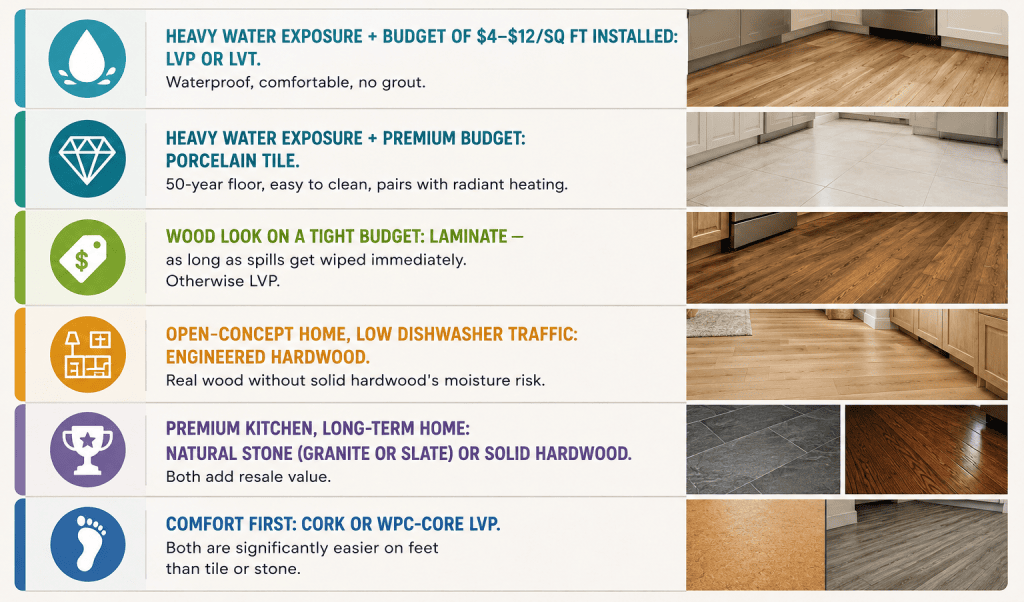
Your kitchen flooring choice ends up depending on your specific priorities and constraints. Water resistance matters most, so porcelain tile and LVP lead in moisture-prone areas. Solid hardwood suits open-concept spaces if you’re willing to manage spills right away. Budget matters just as much: laminate delivers wood esthetics at a lower cost, while natural stone commands premium pricing with lifetime durability.
Don’t expect any flooring to excel at everything. Each option trades off comfort against maintenance and longevity, or cost against other benefits. I recommend identifying your top three priorities (waterproofing, budget, or esthetics), then selecting the flooring that best matches those needs while accepting its limitations.