In this guide
Color gets most of the attention when people plan a paint job. Finish is what actually determines how the wall holds up. A flat paint in a bathroom peels within a year. Semi-gloss in a bedroom with uneven plaster turns every divot and patch into a spotlight. The wrong finish doesn’t just look off—it fails faster, cleans worse, and costs you a repaint you didn’t plan for.
This guide covers what each finish actually does, why the room you’re painting changes the answer, and how wall condition factors into the decision.
What Sheen Level Controls
Paint finishes differ in how much binder they contain relative to pigment. More binder means a harder, shinier surface that reflects more light, less binder is a softer, more porous finish that absorbs light.
That difference has two practical consequences. Higher sheen finishes are well washable. They’re less forgiving of surface flaws. Sheen reflects light at consistent angles, which makes every bump or patch visible. Flat finishes scatter light in all directions, that’s the reason they’re so effective at hiding textured or damaged walls.
The core trade-off in selecting a finish: durability of the paint vs. surface concealment. The room tells you which one matters more.
Paint Finishes
Flat & Matte
No sheen at all. Light scatters across the surface rather than reflecting, which is why flat paint hides imperfections better than any other finish. Dings, patches, and uneven texture disappear under flat paint in a way they don’t under anything glossier.
The trade-off is durability. Flat paint is porous—moisture and grease penetrate the surface rather than sitting on top of it. Wiping a flat wall too aggressively removes paint along with the dirt. It’s not a good choice for any surface that gets touched regularly.
This one is the right choice for ceilings and bedrooms with a low traffic. Most manufacturers recommend it specifically for ceilings because they never get scrubbed.
Eggshell
Slight sheen—closer to flat than satin, but durable enough to handle a damp cloth. It’s the workhorse finish for most interior walls. Eggshell still conceals moderate surface imperfections reasonably well, and it holds up to occasional cleaning without wearing through.
Bedrooms, living rooms, and dining rooms are the standard applications. Benjamin Moore describes eggshell as ideal for moderate-traffic areas where some cleanability is needed but the room doesn’t get the daily wear of a kitchen or bathroom.
Satin
Satin lands between eggshell and semi-gloss. The sheen is low-key—nothing mirror-like—but the surface holds up to scrubbing, not just a damp wipe. Moisture resistance is good enough for kitchens and bathrooms that have a working exhaust fan.
It’s the most versatile finish on the list. Kids’ rooms, hallways, laundry rooms—anywhere that sees regular contact and occasional spills. The sheen level is moderate enough that it doesn’t amplify every wall imperfection the way semi-gloss does.
Satin is also a common choice for trim in rooms where the walls are painted eggshell—the contrast in sheen between wall and trim adds visual definition without requiring two dramatically different colors.
Semi-Gloss
Semi-gloss has a noticeable sheen and holds up well against moisture and regular cleaning. It’s the go-to for trim, doors, window casings, and baseboards—surfaces that get touched constantly and need to be wiped down without the paint wearing through.
On walls, it’s best reserved for rooms where moisture is the primary concern: bathrooms, laundry rooms, and kitchens without satin already applied. The catch is that semi-gloss on a wall with any surface irregularities makes those irregularities visible. Wall prep has to be thorough before applying semi-gloss—skim coat, sand, prime.
High-Gloss
The hardest, most reflective finish available. It wipes clean easily, resists moisture completely, and holds up under heavy use. It also shows every surface flaw in sharp relief and requires near-perfect prep to look intentional rather than sloppy.
High-gloss suits cabinets, furniture, and accent trim where the reflective surface is intentional. On anything less than near-perfect prep, it reads as a mistake rather than a choice. Sherwin-Williams recommends it for doors and trim where durability and easy cleaning matter more than hiding surface variation.
Quick Reference
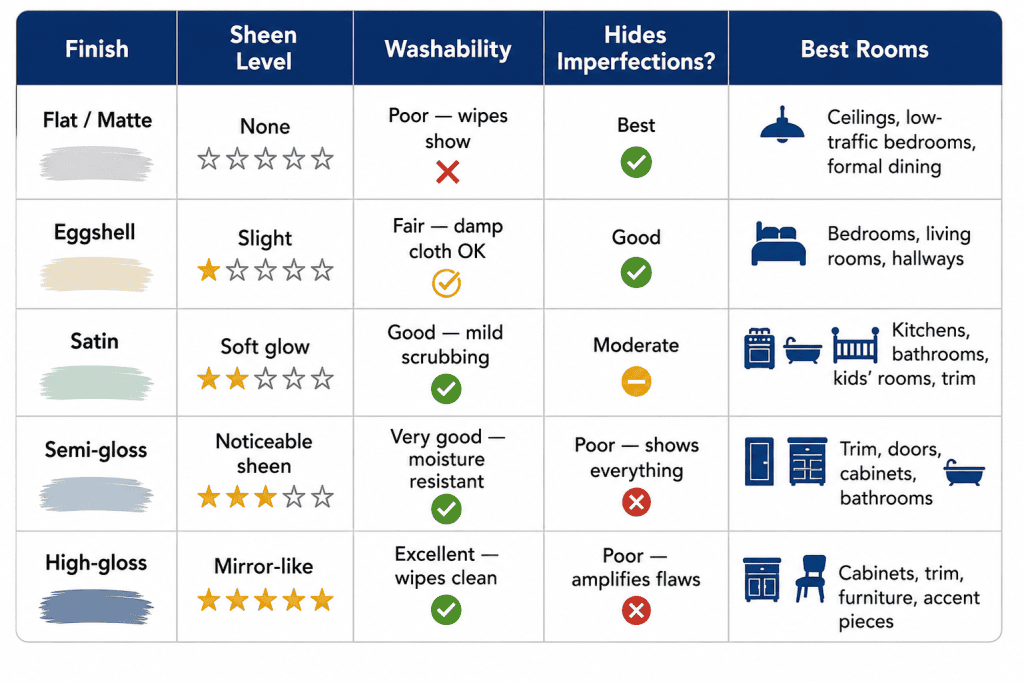
Finish Options
Ceilings
Flat, every time. Ceilings never need washing, and the zero-sheen surface prevents glare from light fixtures. Ceiling flat paint is often sold separately from wall flat paint—it tends to be thicker and more splatter-resistant for overhead application.
Bedrooms
Eggshell on walls is the standard choice—some cleanability without the sheen that would expose every texture variation in older plaster. Satin on trim. If the bedroom belongs to a child, move up to satin on the walls; crayon and handprints need more than a damp cloth.
Living Rooms
Eggshell suits most living rooms. Dining rooms with wallpaper or heavily textured walls do better with flat—flat paint doesn’t emphasize the texture the way eggshell or satin would. Satin or semi-gloss on all trim, regardless of wall finish.
Kitchens
Satin is the practical choice. Kitchens generate grease, steam, and frequent contact—satin handles all three without the prep demands of semi-gloss on walls. Sherwin-Williams recommends satin for kitchen walls. Cabinets are a separate call—semi-gloss or high-gloss on the faces gives a harder surface that holds up to daily opening, closing, and cleaning.
Bathrooms
Moisture is the governing factor. Flat and eggshell absorb humidity and eventually peel, bubble, or grow mold behind the surface. Satin is the minimum for bathroom walls; semi-gloss in smaller bathrooms or those without a window or exhaust fan. Always use paint labeled as mold- and mildew-resistant in bathrooms—the antimicrobial additives matter in confined, humid spaces.
Hallways and Entryways
Satin. These are the highest-contact surfaces in most homes—shoulders brushing the wall, hands reaching for light switches, kids running through with bags. Eggshell wears through at contact points faster than it does in low-traffic rooms.
Trim, Doors, and Baseboards
Semi-gloss is the standard call for trim, doors, and baseboards. It cleans easily, holds up to daily contact, and the contrast in sheen between trim and wall adds visual separation without needing a color change. Front doors often get high-gloss—exterior conditions are harder on paint than interior ones, and a glossier surface holds up better against sun and rain than semi-gloss would.
Check the Wall Before You Commit
The glossier the finish, the more the wall underneath has to earn it. A freshly skimmed, sanded, and primed wall takes any finish well. A wall with visible patches, texture variations, or previous paint buildup narrows the options.
- Significant texture or previous repair work: flat or eggshell—anything glossier amplifies the variation.
- Good condition with minor imperfections: eggshell or satin—moderate prep handles it.
- Near-perfect condition: any finish works. Good prep is what makes higher-sheen finishes viable—not the other way around.
The cost of using the wrong finish on unprepared walls isn’t just cosmetic—it’s the cost of repainting. Flat paint is forgiving enough to go over moderate imperfections. Semi-gloss on the same wall without prep will require a full skim coat before it looks right.
One More Variable: Paint Quality
Finish choice matters less when the quality of the paint is poor. A budget flat paint in a bedroom will mark and scuff faster than a premium eggshell. Consumer Reports’ paint testing consistently shows meaningful differences in scrub resistance and coverage between budget and mid-range paint—differences that become obvious within a year of normal use. Spending $15–$20 more per gallon on a good paint in the right finish beats spending the same amount on a budget option in a slightly higher sheen.
Sources
Every external claim in this guide links to its origin. Collected automatically from the text above.
- Most manufacturers recommend — lifeofanarchitect.com
- Benjamin Moore describes — benjaminmoore.com
- the contrast in sheen between wall and trim adds visual definition — livingetc.com
- Sherwin-Williams recommends — sherwin-williams.com
- Consumer Reports' paint testing — consumerreports.org

Nina Kowalski
Nina covers flooring, renovation planning, and DIY repair guides for Decor Modern. Her focus is translating contractor-level knowledge into step-by-step instructions that a homeowner can actually follow on a Saturday morning. Before writing about home improvement, Nina spent four years managing renovation projects for residential properties in the Midwest — coordinating work between flooring installers, painters, and general contractors. She worked on projects ranging from single-room updates to full-home renovations, gaining firsthand experience in budgeting, timelines, and contractor coordination. That experience taught her which shortcuts work, which ones backfire, and how much things really cost when the estimate meets reality. She saw how initial estimates change once work begins — and which decisions tend to increase costs or cause delays. Her most-read articles on Decor Modern include a guide to fixing scratches on hardwood floors and a breakdown of the cost to refinish hardwood floors. She also writes the site's cost comparison pieces, where she digs into real pricing data rather than repeating vague national averages. Her writing is grounded in real project constraints — including labor availability, material costs, and unexpected issues that arise during renovation. Nina holds a degree in Communications and has contributed home improvement content to several online publications. She lives in Ohio, where she is currently refinishing the original oak floors in a 1948 Cape Cod — one room at a time.